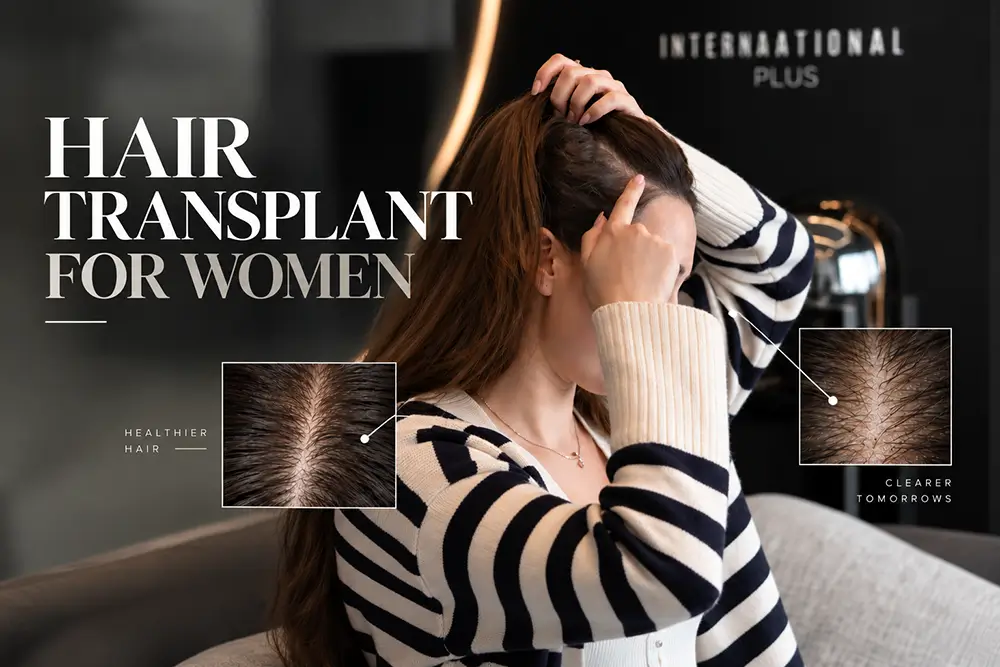
A hair transplant for women is a very different operation from the male equivalent and the biggest difference is who qualifies. Most men with pattern loss keep a stable donor zone. Most women do not. That single fact decides whether surgery helps or wastes irreplaceable donor hair. This International Plus guide covers the eligibility gate, the medical workup that must come first, the technique choice that suits female scalps, plus the realistic pathway for women who are not surgical candidates.
Key Takeaways
- Eligibility for a hair transplant for women rests on donor stability, not on how thin the part line looks since grafts from an unstable donor zone thin at the same rate.
- Diffuse unpatterned alopecia affects a large share of women with thinning hair and rules out surgery, which is why miniaturisation mapping precedes every offer.
- A medical workup covering thyroid, ferritin, vitamin D plus hormones separates reversible shedding from androgenetic loss.
- FUT frequently outperforms FUE in women because a strip harvest avoids full clipping while yielding more grafts from a small safe zone.
- Surgery relocates hair without halting progression so physician-assessed medical support usually continues afterwards.
What Is a Hair Transplant for Women?
A hair transplant for women is the surgical relocation of follicles from a stable donor zone into thinning areas along the part line, temples or hairline. Roughly 1 in 4 women experience noticeable hair loss during adult life. Diagnosis decides eligibility, never the desire for more density.
Definitions matter because the operation differs from male surgery in almost every planning decision. Women more often need density across an existing part rather than a newly drawn frontal hairline. According to Queen and colleagues in the Journal of Drugs in Dermatology (2025), hair transplantation in women demands an assessment pathway distinct from male pattern surgery. In practice, our clinicians open every female consultation with diagnosis first rather than with graft counting. A women’s hair transplant is planned around what the donor area can safely release across a lifetime since the safe zone is smaller in most female scalps.
Why Are Only Some Women Surgical Candidates?
The eligibility gate is the stability of the donor zone. A woman with donor pattern alopecia keeps a dense occipital zone resistant to hormonal miniaturisation. A woman with diffuse unpatterned alopecia thins across the entire scalp including the donor area. Over 50% of women with thinning fall into the second group.
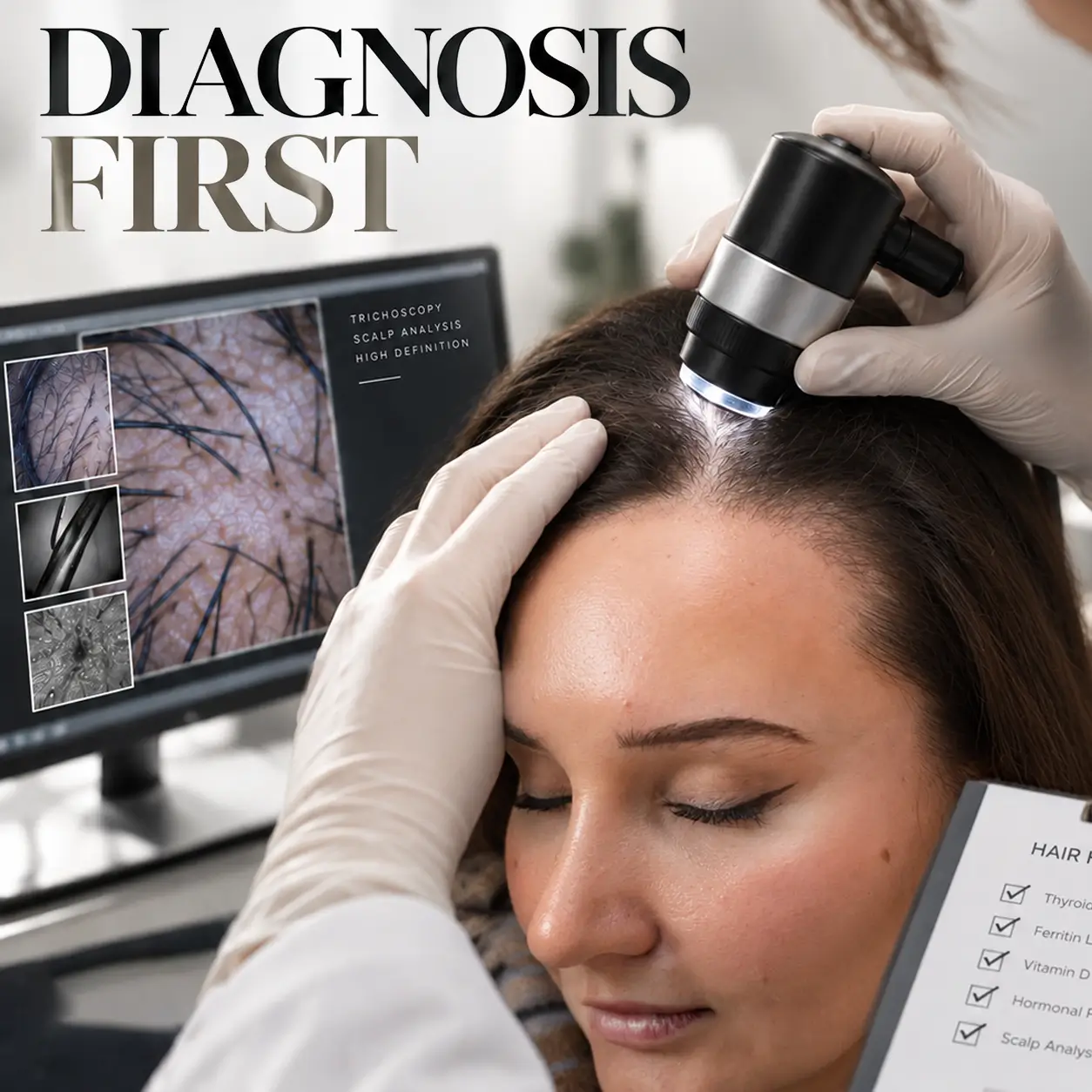
Two profiles explain the split. Donor pattern alopecia, abbreviated DPA, leaves the occipital scalp intact so relocated follicles keep growing in the new site. Diffuse unpatterned alopecia, abbreviated DUPA, miniaturises everywhere. Transplanted hair then thins on the same schedule as the rest. Carman and colleagues in Facial Plastic Surgery (2024) placed donor area management at the centre of surgical planning for exactly this reason. For example, a woman showing visible thinning at the occipital scalp under magnification is screened out rather than operated on. Our surgeons run miniaturisation mapping using Trichoscopy before any surgical offer is made.
How Does Female Pattern Hair Loss Differ From Male Pattern?
Female pattern hair loss is a diffuse thinning across the mid-scalp and part line that usually spares the frontal hairline. Male pattern loss recedes from the temples toward the crown instead. Clinicians grade the female presentation on the Ludwig scale across 3 stages rather than on 7 Norwood stages.
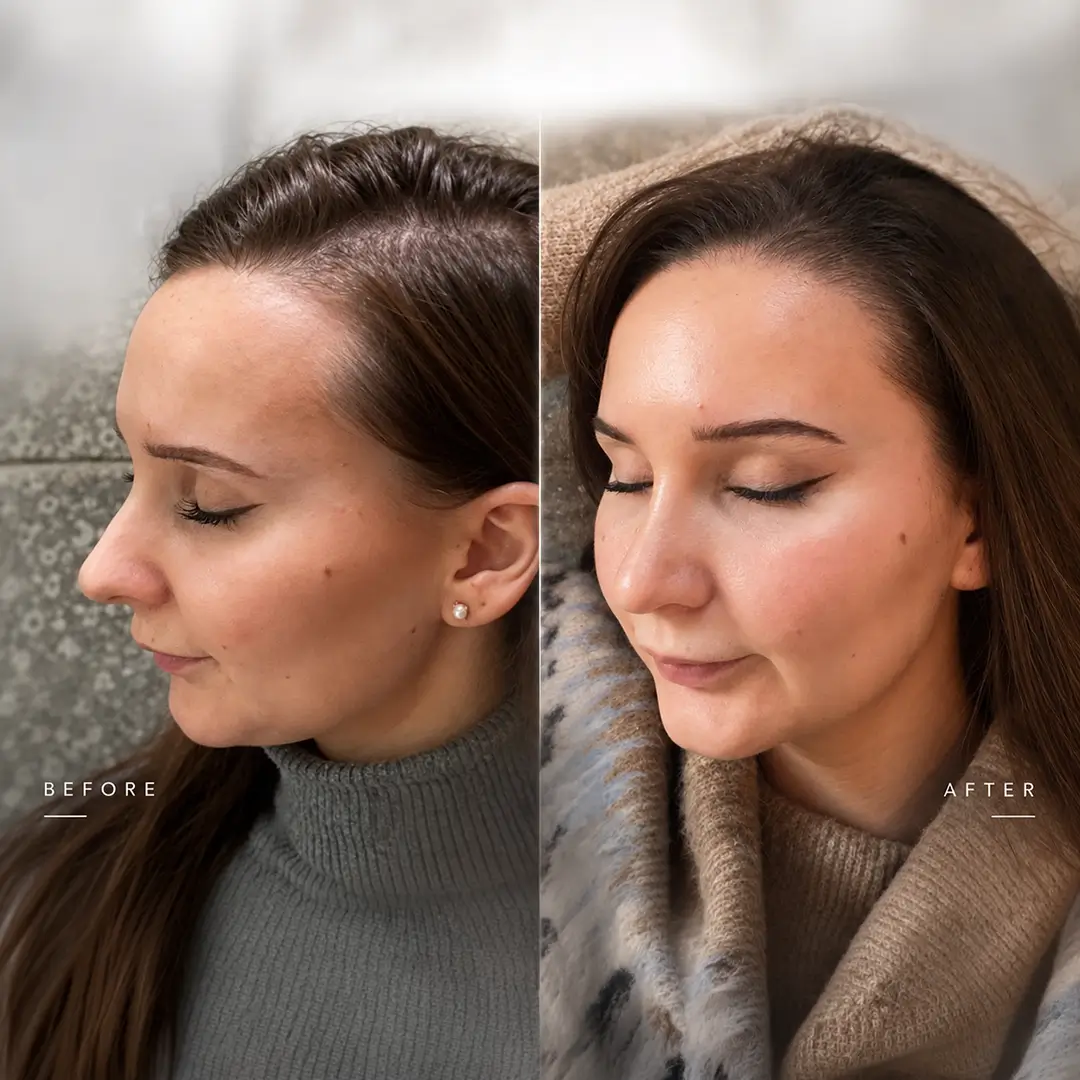
Pattern shapes the whole surgical plan. A retained hairline means grafts must be threaded between surviving hairs without transecting them, which demands smaller recipient sites plus slower placement. According to Müller Ramos and colleagues in Anais Brasileiros de Dermatologia (2023), female pattern hair loss follows a therapeutic pathway distinct from the male condition. Widening of the central part is usually the first change women notice. For instance, a woman describing a part that doubled in width over 24 months is describing active progression, not a static problem. Our clinicians photograph the part line under fixed lighting at every visit, then compare across 12 months. The DHI implantation route is often selected for exactly this between-hairs work.
What Medical Workup Comes Before Surgery?
The pre-surgical workup for women is a medical investigation rather than a cosmetic consultation, covering 4 blood markers at minimum. Thyroid function; ferritin; vitamin D; a hormonal panel are checked because reversible causes mimic pattern loss closely. Trichoscopy separates androgenetic loss from telogen effluvium, with a scalp biopsy added in unclear cases.
Reversible causes are common and surgery cannot fix any of them. Telogen effluvium after childbirth, illness, rapid weight change or a medication switch resolves once the trigger clears, which is why an operation booked during an active shed wastes donor hair. Dakkak and colleagues in American Family Physician (2024) set out the diagnostic sequence separating these conditions. Iron deficiency deserves particular attention in menstruating women. Real-world assessment at our clinic includes 6 months of observation when the picture stays unclear because operating on an undiagnosed scalp is the most expensive mistake available. Planning figures sit in our breakdown of hair transplant cost.
| Presentation | Typical donor zone | Surgical suitability |
| Donor pattern alopecia (DPA) | Stable, dense occipital zone | Usually suitable after mapping |
| Diffuse unpatterned alopecia (DUPA) | Thinning across the whole scalp | Not suitable, medical pathway instead |
| Traction alopecia, stabilised | Usually intact | Often suitable once styling stops |
| Telogen effluvium, active | Intact but shedding | Defer, treat the trigger first |
| Scarring alopecia, uncontrolled | Variable | Defer until dermatological control |
Suitability in the table above is a starting framework, confirmed only by an examining physician.
Is FUE or FUT Better for Women?
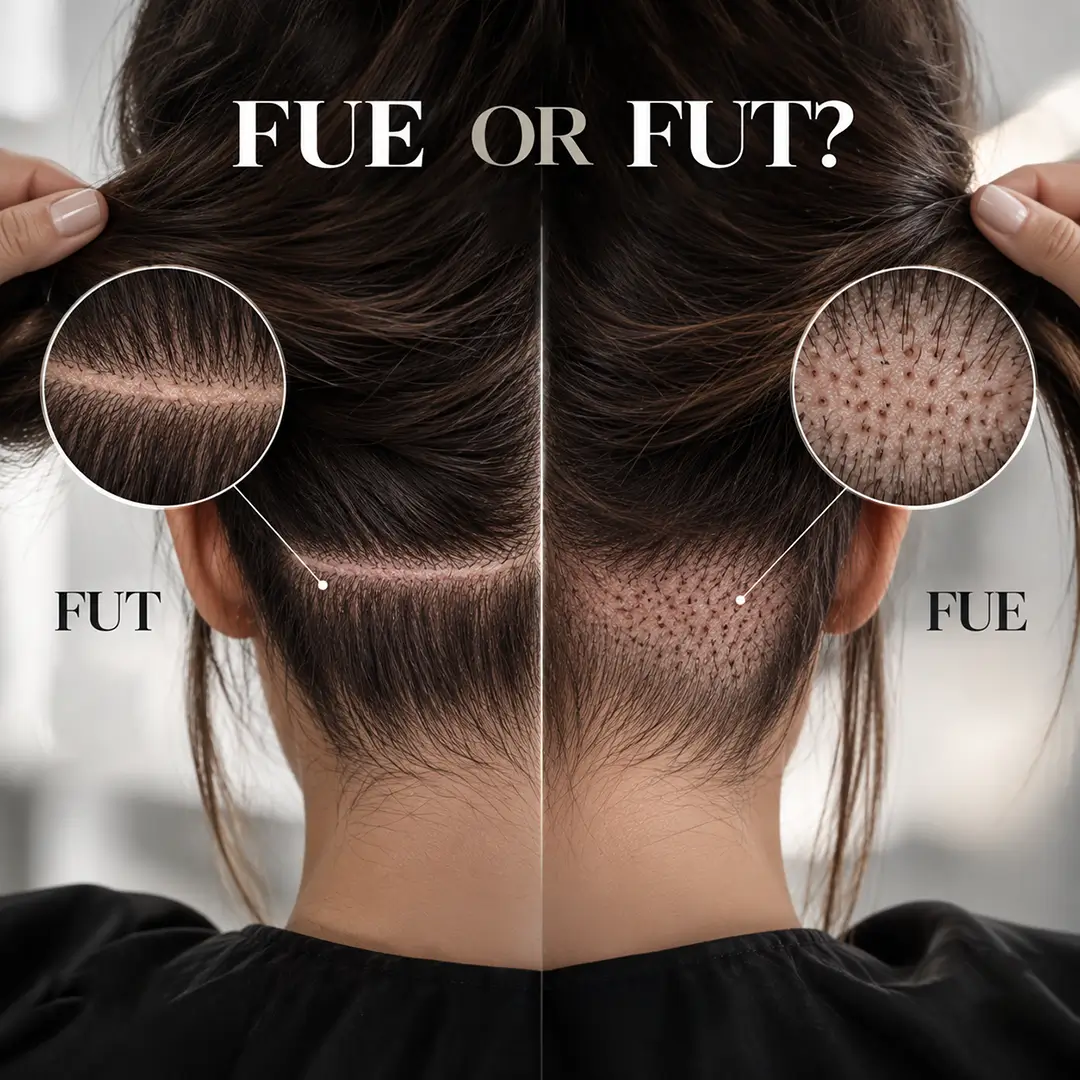
FUT is the technique many surgeons prefer for women because a strip harvest yields more grafts from a limited safe donor zone without clipping the whole head. FUE needs a shaved donor area and sessions above 2,000 grafts usually require broad clipping. Neither method is automatically correct for a hair transplant procedure in a female scalp.
Practical trade-offs decide the choice. FUT leaves a linear donor scar hidden under longer hair while FUE leaves scattered dot scars visible if hair is worn very short. Long-hair or partial-shave protocols exist. Park and colleagues in Annals of Plastic Surgery (2019) noted that non-shaven extraction demands more operative time. FUE suits a woman planning short hairstyles but rarely suits one refusing any visible clipping because a full session cannot be hidden. In practice, our surgeons present both routes with photographs of healed donor areas, then let the patient decide. The expected growth timeline runs the same either way.
Does a Hair Transplant Work for Traction Alopecia?
Traction alopecia is a hair loss pattern caused by sustained pulling from tight braids, weaves or repeated tension styling. The condition ranks among the strongest surgical indications in women. Surgery works only after the styling practice stops and the loss stabilises for at least 12 months.
Scarring changes the surgical calculation. Long-standing traction damage destroys follicles permanently. The recipient bed then accepts fewer grafts with blood supply sometimes reduced. Central centrifugal cicatricial alopecia, common in women with Afro-textured hair, needs dermatological control before any surgical discussion. According to Devjani and colleagues in Drugs (2023), medical stabilisation precedes any surgical planning. Textured hair also curves beneath the skin, which raises transection risk during extraction. For example, our surgeons run a small test extraction on curly donor hair before committing to a full session. Framing work such as an eyebrow transplant follows the same caution.
What Should Women Expect After Surgery?
Recovery for women is the same arc of 12 months as male surgery: shedding between weeks 2 and 6; dormancy through months 2 and 3; visible growth from month 4; maturation to month 18. Native hair around the grafts can shed temporarily, which makes month 3 look worse than the starting point.
Two realities deserve stating plainly. Surgery relocates hair without stopping the underlying condition. Continuing loss in untreated zones remains likely so physician-assessed medical support usually continues alongside. Loh and colleagues documented localised telogen effluvium after transplantation in Annals of Dermatology (2018), which explains the temporary thinning many women notice at month 2. For instance, our follow-up team schedules reviews at month 3, month 6, month 12 so progression is separated from surgical outcome. International patients arrange remote reviews through our medical travel framework while verification steps sit in the overview of the most trusted clinics in Turkey. Choosing a hair transplant for women starts with a diagnosis, never with a graft number. International Plus holds a 4.8/5 rating over 5,504 verified reviews and individual results vary.
Book a diagnostic consultation with our coordination team and receive a written candidacy assessment before any surgical plan is discussed.
Frequently Asked Questions
Can most women have a hair transplant?
No. A large share of women with thinning hair have diffuse unpatterned alopecia, meaning the donor zone itself is miniaturising. Grafts taken from an unstable donor area thin at the same rate as the rest. Only women with a confirmed stable donor zone are surgical candidates.
Do women need to shave their head for surgery?
Not necessarily. A strip harvest hides the donor site under surrounding hair without full clipping. FUE requires a shaved donor zone though partial-shave and long-hair protocols exist for smaller sessions. Larger FUE cases above roughly 2,000 grafts usually need broader clipping to work accurately.
What causes female pattern hair loss?
Genetic predisposition combined with hormonal sensitivity drives most cases with menopause, polycystic ovary syndrome and thyroid disease as common contributors. Iron deficiency, rapid weight change and significant stress can produce a separate reversible shedding. A physician distinguishes between these before any surgical discussion begins.
Is a hair transplant suitable for traction alopecia?
Often yes provided the styling practice causing the tension has stopped and the loss has been stable for at least 12 months. Long-standing traction damage scars the scalp, which lowers how many grafts a recipient bed accepts. A dermatological assessment confirms whether follicles remain viable.
What determines the cost of a hair transplant for women?
Graft count, technique, session length, surgical team seniority plus the clinic cost base drive the figure, exactly as in male surgery. Diagnostic workup adds a separate line. A responsible quote follows blood tests and donor mapping rather than appearing on a website before any examination.
How long until female hair transplant results show?
Transplanted shafts shed between weeks 2 and 6, then regrowth begins around month 4. Density usually reads at month 8 to month 10. Final maturation runs to month 18. Results often read later in women because diffuse thinning surrounds the treated zone rather than framing a defined patch.
Reviewed by Dr. Eren Gülbahar
References
- Queen D, et al. J Drugs Dermatol. 2025. PMID: 40911748
- Carman TP, et al. Facial Plast Surg. 2024. PMID: 38049108
- Müller Ramos P, et al. An Bras Dermatol. 2023. PMC10334345
- Dakkak M, et al. Am Fam Physician. 2024. PMID: 39283847
- Park JH, et al. Ann Plast Surg. 2019. PMC6392215
- Devjani S, et al. Drugs. 2023. PMC10173235
- Loh SH, et al. Ann Dermatol. 2018. PMC5839894
Follow us on Social Media
internationalplusofficial
internationalplus
internationalplusdental
This content is written, reviewed, and approved by the International Plus Medical Review Board to ensure clinical accuracy and adherence to strict editorial standards. All medical information is regularly monitored, audited and updated in light of the latest scientific advancements.
However the information provided here is for general informational purposes only and cannot be used for self diagnosis or making individual health interpretations. Results of medical treatments depend on individual anatomy and the unique healing process of each patient. This information should not replace a personal consultation with a qualified healthcare professional. To understand the best options for your specific needs and to receive a personalized treatment plan, we invite you to book a free consultation with the expert medical team at International Plus.

I am a healthcare professional with over 4 years of experience in dentistry, specializing in prosthetic dental treatment and implant-based applications. Since 2024, I have been serving as chief physician, leading clinical management, team coordination, and international patient processes. With my B2-level English proficiency, I am able to communicate effectively with international patients. I am a patient-centered, innovative, and solution-oriented dentist who prioritizes patient satisfaction.