Patients rarely book a dental appointment because of heartburn. They book because a front tooth has turned slightly see through or because cold water has started to sting. Acid reflux teeth damage follows a pattern a dentist can read on sight and that pattern differs from the one sugar or night clenching leaves. This International Plus guide covers what gastric acid does to enamel, which surfaces it reaches first plus how the damage is rebuilt.
Key Takeaways
- Enamel dissolves below a surface pH of about 5.5 while gastric fluid arrives near pH 2.
- Pooled data place dental erosion in roughly 24% of people with diagnosed reflux disease.
- The reflux pattern begins on the palatal surfaces of the upper front teeth, then reaches molar surfaces.
- Acid erosion is chemical dissolution, which separates it from bacterial decay and from grinding wear.
- Brushing straight after a reflux episode strips softened enamel so rinse with water first.
What Does Acid Reflux Do to Your Teeth?
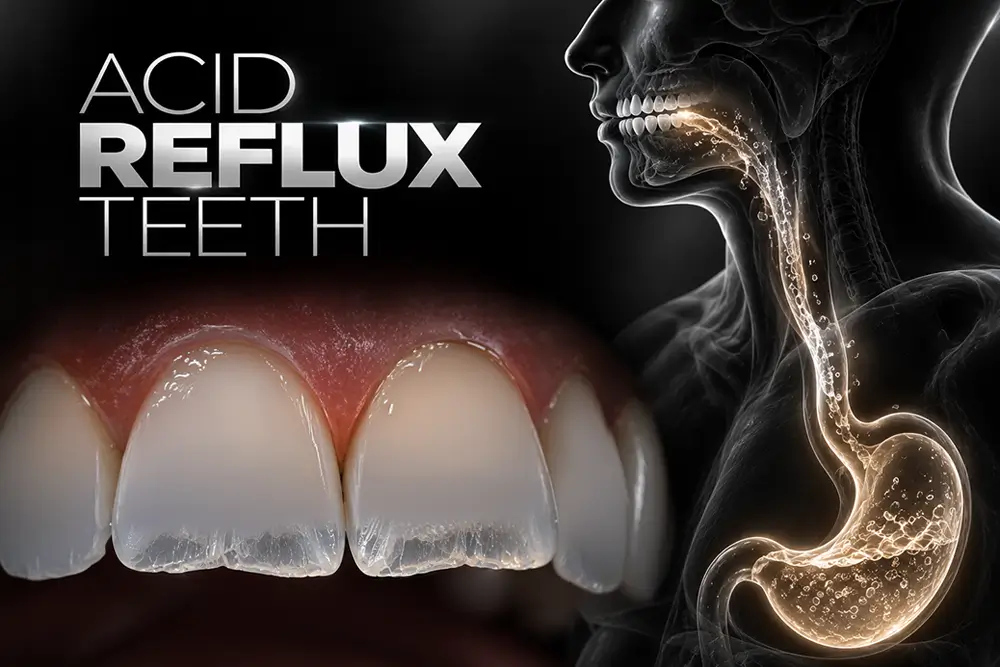
Acid reflux dissolves the mineral surface of enamel. Gastric fluid reaching the mouth sits near pH 2, far below the pH of roughly 5.5 at which enamel begins to demineralise. Each episode softens the outer layer and repeated episodes carry it away. Enamel contains no living cells so the tissue never grows back.
Scale matters more than any single episode. An overview of systematic reviews by Chatzidimitriou and colleagues in the 2023 Journal of Dentistry reported a median erosion prevalence around 24% among patients with gastro-oesophageal reflux disease. A 2022 meta-analysis in Dentistry Journal from Yanushevich and colleagues reached the same conclusion from pooled patient samples. Two features make gastric acid harsher than a lemon. Hydrochloric acid is stronger than dietary acid and pepsin travelling with it strips the protein pellicle that normally shields enamel. At International Plus, every patient who reports frequent heartburn is charted surface by surface rather than tooth by tooth since erosion is a map of where the acid pooled.
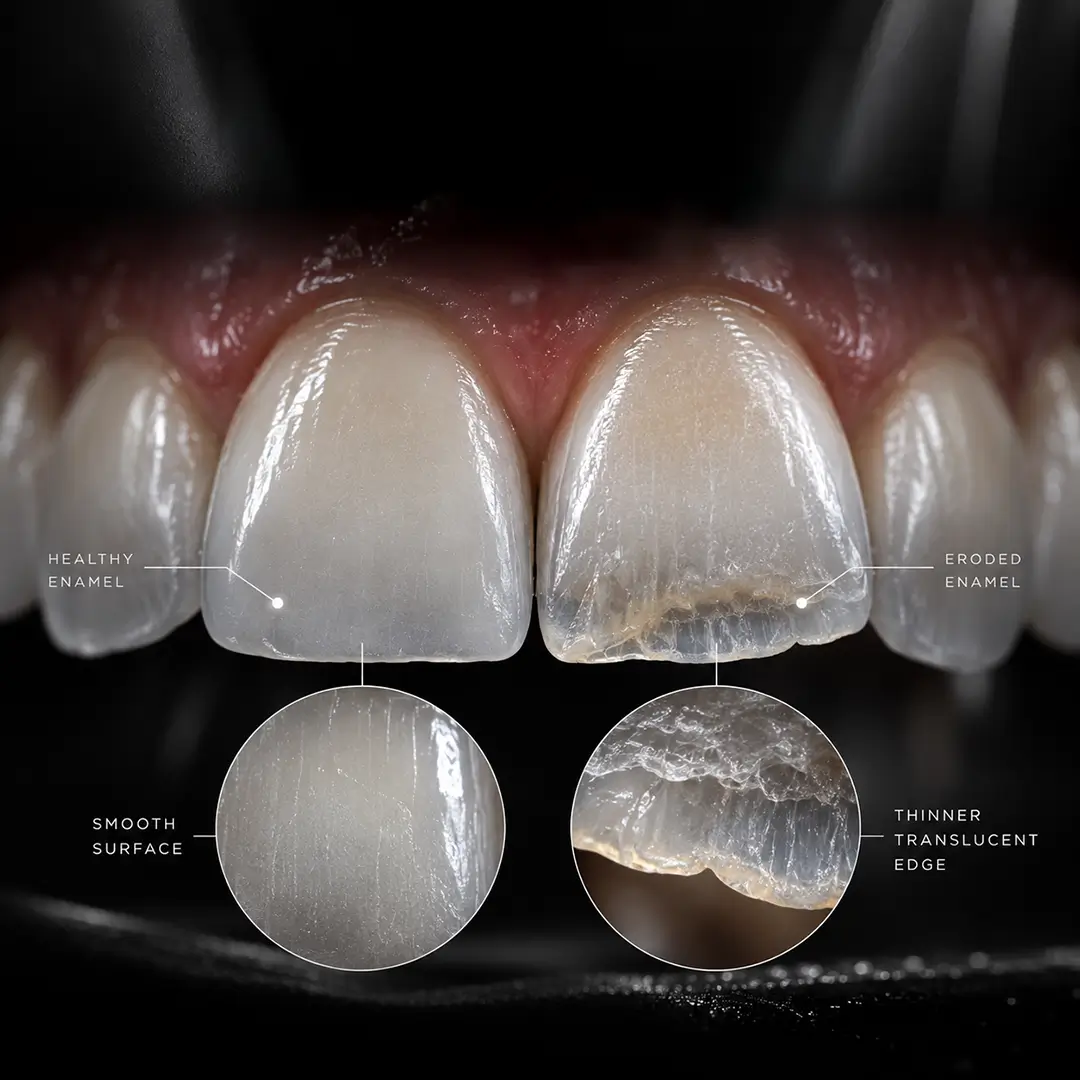
Erosion, Cavities or Grinding: Which Kind of Damage Is It?
Three processes wear teeth down and they need separate treatment. Acid erosion is chemical dissolution by acid that no bacteria produced. Tooth decay is dissolution by acid that plaque bacteria produce. Attrition is mechanical loss from tooth against tooth contact. A single mouth often shows all three, which is why the distinction is drawn surface by surface.
| Feature | Acid erosion | Tooth decay | Grinding wear |
| Driver | Gastric or dietary acid | Plaque bacteria on the surface | Tooth against tooth force |
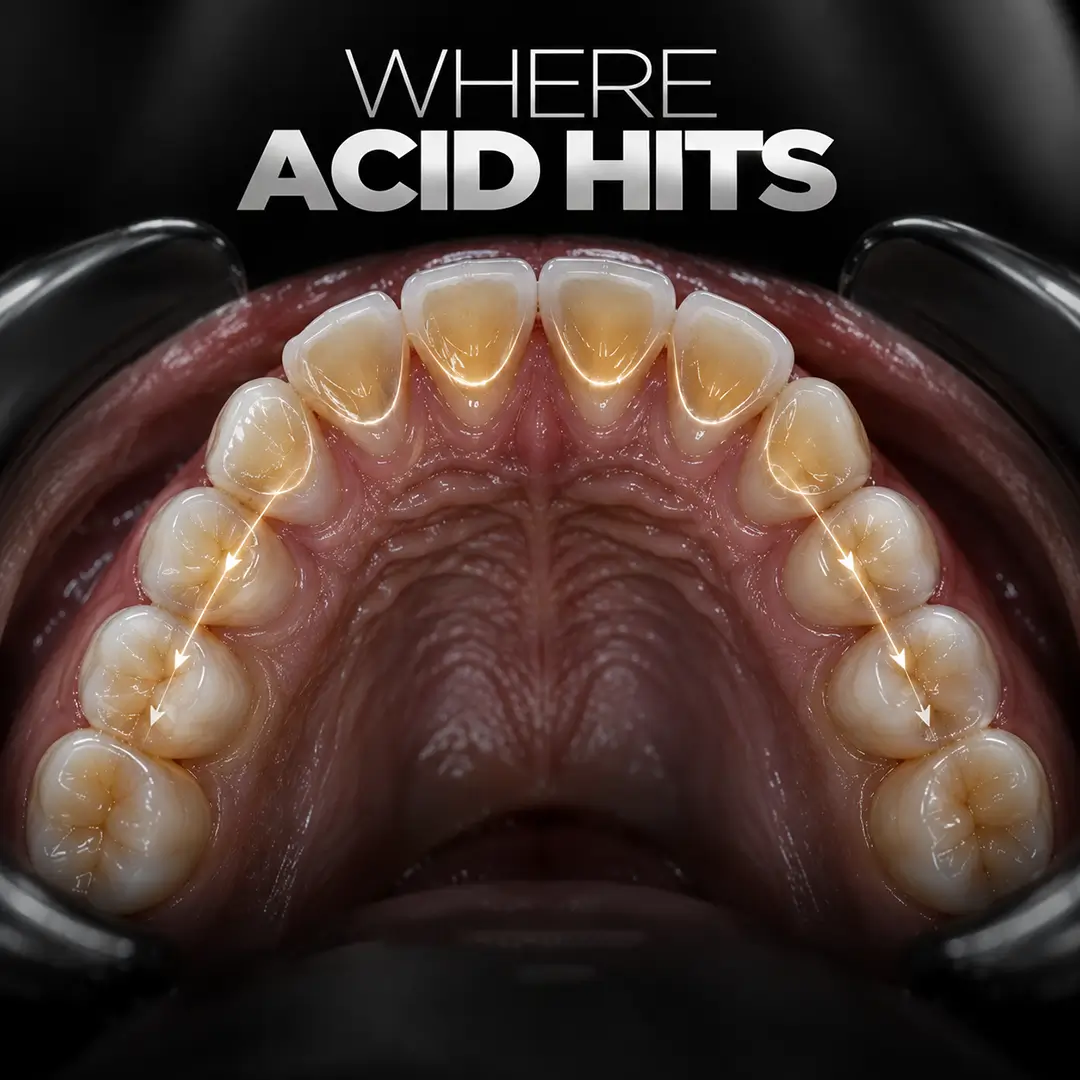
| Usual site | Palatal surfaces of upper front teeth, molar cups | Grooves and contact points | Incisal edges and cusp tips |
| Appearance | Smooth, glossy, rounded outline | Chalky white patch, then a cavity | Flat facets with sharp borders |
| Early complaint | Cold sensitivity across several teeth | Ache in one tooth | Jaw tightness on waking |
Bottom line: the surface that is worn tells the clinician which process is active, long before any restoration is planned.
The classic review of wear mechanisms by Barbour and Rees in the Journal of Clinical Dentistry set out how erosion, abrasion plus attrition interact rather than compete. Readers whose main problem is bacterial breakdown should turn to our guide on how cavities form and are treated while flattened facets and morning jaw tightness point toward teeth grinding and its management. Where acid has exposed dentine the resulting sensitivity to cold and sweet foods is a symptom of erosion rather than a separate condition.
What Are the Signs of Acid Reflux on Teeth?
Early signs of reflux erosion are subtle and easy to attribute to age. Upper front teeth look glassy or slightly translucent near the biting edge. Cold drinks sting across several teeth at once. Old fillings begin to stand proud of the surrounding surface because the tooth around them has worn while the filling has not.
Distribution separates gastric erosion from the dietary kind. Acid from the stomach settles first on the palatal surfaces of the upper incisors, then on the occlusal cups of molars whereas fizzy drinks and citrus attack the outward facing surfaces the liquid washes over. A 2014 chapter on diagnosis by Ganss and Lussi in Monographs in Oral Science describes the graded scoring systems clinicians use for these lesions, including the Basic Erosive Wear Examination. A tooth thinned enough to show underlying dentine looks darker rather than stained, which differs from ordinary yellowing and surface discolouration. None of these findings diagnoses reflux on its own. They justify a dental examination and, where the pattern fits, a gastroenterology referral.
Book Your Free Consultation and send photographs of your front teeth to our clinical team through the 24 hour patient coordination line.
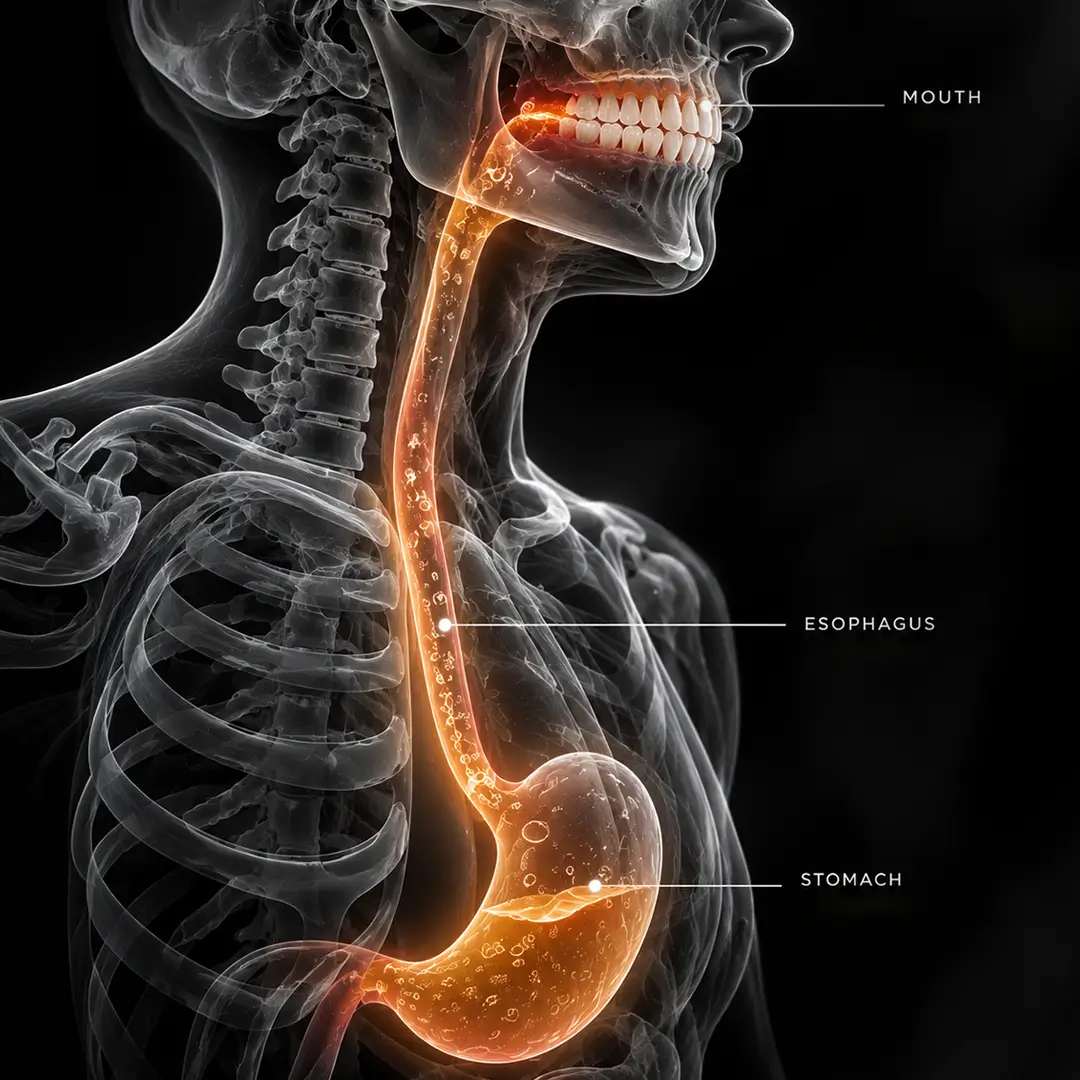
Why Silent Acid Reflux and Night Reflux Do More Damage
Reflux that produces no heartburn still reaches the teeth. Silent acid reflux is the term for episodes without the familiar burning sensation and patients in that group often learn about the problem from a dentist. Night time episodes cause disproportionate harm because two protective mechanisms shut down together during sleep.
Saliva is the first mechanism. Salivary flow falls close to zero during sleep and the classic review of flow patterns by Dawes in the 2008 Journal of the American Dental Association quantified how clearance of any substance from the mouth depends on that flow. Swallowing is the second. A sleeping patient swallows rarely so acid that arrives stays in contact with enamel for minutes rather than seconds and lying flat lets it pool around the back teeth. Reduced flow from other causes compounds the effect, which is why patients coping with a persistently dry mouth erode faster at the same reflux frequency. Repeated vomiting produces the same palatal pattern whatever its cause. Anyone in that situation, including someone living with an eating disorder, deserves medical support alongside dental care.
How to Protect Teeth From Acid Reflux
Protecting teeth from reflux means shortening the time acid spends on enamel. Rinse with plain water immediately after an episode. Wait at least thirty minutes before brushing because softened enamel abrades under a brush that would be harmless on a hard surface. Use a soft brush with fluoride toothpaste once the surface has rehardened.
Fluoride does measurable work here. A 2024 network meta-analysis in Clinical Oral Investigations from Creeth and colleagues pooled in situ studies and found daily fluoride treatments remineralise eroded enamel lesions with stannous containing formulations performing strongly. High fluoride toothpaste works well for surfaces that are still softening but it will not rescue a tooth that has lost a third of its crown height because remineralisation rebuilds a thin surface layer rather than missing bulk. Chewing sugar free gum after meals raises salivary flow and shortens clearance time. Lowering reflux frequency helps most of all and those decisions belong to the doctor managing your condition. Nothing here is a reason to change a prescribed treatment. Inflamed gum margins are addressed through gum disease treatment and periodontal care before any restorative work begins.
How Dentists Restore Teeth Worn by Acid Erosion
Restoration follows the extent of tissue loss rather than the patient’s discomfort. Mild cases need records and review, not drilling. Moderate loss is rebuilt with adhesive composite. Advanced wear across both arches calls for a staged plan that re establishes vertical dimension. Reflux control comes first in every version since restoring into an uncontrolled acid environment repeats the failure.
| What the examination shows | Usual approach |
| Surface softening, tooth shape unchanged | Fluoride protocol, photographic records, review at six months |
| Localised enamel loss with cold sensitivity | Adhesive composite build up on the affected surfaces |
| Exposed dentine, cupped molar surfaces | Onlays or crowns on the worn units |
| Reduced bite height across both arches | Staged full mouth rehabilitation with planned vertical dimension |
Bottom line: the least invasive option that halts the loss is preferred and monitoring counts as treatment.
Contemporary practice favours patience. The tooth wear guide from Loomans and colleagues in the 2018 British Dental Journal argues for counselling and monitoring before restorative intervention while a 2025 review of direct restorations by Mehta and colleagues in Monographs in Oral Science supports composite as the first restorative step for erosive tooth wear lesions. In our practice we photograph and scan the eroded arch at the first visit rather than restoring immediately because a second set of records six months later separates active wear from wear that stopped years ago. Cases with reduced bite height are planned by our Diagnostic Council with input from Dr. Celal Aktay, whose doctoral work in prosthetic dentistry covered excessive tooth wear.
Thinned teeth fracture more easily so anyone arriving with a cracked or split tooth is assessed for underlying erosion and a tooth where acid has reached the pulp is stabilised with root canal treatment by endodontic specialists before rebuilding. International Plus holds 5,504 verified reviews at 4.8 out of 5 and has treated more than 200,000 patients from 140+ countries since 2014. This guide was reviewed for accuracy by Dr. Eren Gülbahar, an American Dental Association member. Individual results vary. This article is educational and is not medical advice.
To have worn or sensitive front teeth assessed alongside your medical history, contact our patient coordination team for a no obligation review.
Frequently Asked Questions
Can a dentist tell if you have acid reflux?
A dentist can recognise the erosion pattern reflux typically leaves, particularly smooth glossy loss on the palatal surfaces of upper front teeth. That finding is a prompt for medical assessment rather than a diagnosis. Confirming reflux disease requires your physician, who may arrange gastroenterology investigation.
Can enamel damaged by acid reflux grow back?
Lost enamel does not regenerate because it contains no living cells. Fluoride and calcium phosphate products can reharden a thin softened surface layer and reduce sensitivity yet structural loss is replaced with bonded composite, onlays or crowns. Halting further acid exposure protects whatever enamel remains, which is why reflux control precedes restoration.
Why should you not brush your teeth after acid reflux?
Acid leaves the enamel surface temporarily softened and brushing during that window removes mineral that would otherwise reharden. Rinsing with plain water clears the acid without abrasion. Most clinicians suggest waiting around thirty minutes before brushing again with a soft brush and a fluoride toothpaste once the enamel surface has rehardened.
Does silent acid reflux still damage teeth?
Silent reflux causes the same chemical damage as reflux with heartburn because the acid reaching the mouth is identical. Patients without burning symptoms simply notice nothing and seek help later. Dentists frequently spot this group first since palatal erosion on upper front teeth appears well before any digestive complaint prompts a medical appointment.
How often should someone with reflux see a dentist?
Patients with diagnosed reflux and visible wear usually benefit from review every three to six months rather than annually. Shorter intervals allow photographs and scans to be compared so active erosion is separated from historic damage. Anyone noticing new sensitivity or a change in how teeth meet should book sooner.
Reviewed by Dr. Eren Gülbahar
References
- Chatzidimitriou K, et al. J Dent. 2023. PMID: 37068653
- Yanushevich OO, et al. Dent J (Basel). 2022. PMC9316498
- Ganss C, Lussi A. Monogr Oral Sci. 2014. PMID: 24993255
- Barbour ME, Rees GD. J Clin Dent. 2006. PMID: 17131710
- Dawes C. J Am Dent Assoc. 2008. PMID: 18460676
- Creeth J, et al. Clin Oral Investig. 2024. PMC11671545
- Loomans B, et al. Br Dent J. 2018. PMID: 29495023
- Mehta SB, et al. Monogr Oral Sci. 2025. PMID: 40435955
Follow us on Social Media
internationalplusofficial
internationalplus
internationalplusdental
This content is written, reviewed, and approved by the International Plus Medical Review Board to ensure clinical accuracy and adherence to strict editorial standards. All medical information is regularly monitored, audited and updated in light of the latest scientific advancements.
However the information provided here is for general informational purposes only and cannot be used for self diagnosis or making individual health interpretations. Results of medical treatments depend on individual anatomy and the unique healing process of each patient. This information should not replace a personal consultation with a qualified healthcare professional. To understand the best options for your specific needs and to receive a personalized treatment plan, we invite you to book a free consultation with the expert medical team at International Plus.

I am a healthcare professional with over 4 years of experience in dentistry, specializing in prosthetic dental treatment and implant-based applications. Since 2024, I have been serving as chief physician, leading clinical management, team coordination, and international patient processes. With my B2-level English proficiency, I am able to communicate effectively with international patients. I am a patient-centered, innovative, and solution-oriented dentist who prioritizes patient satisfaction.