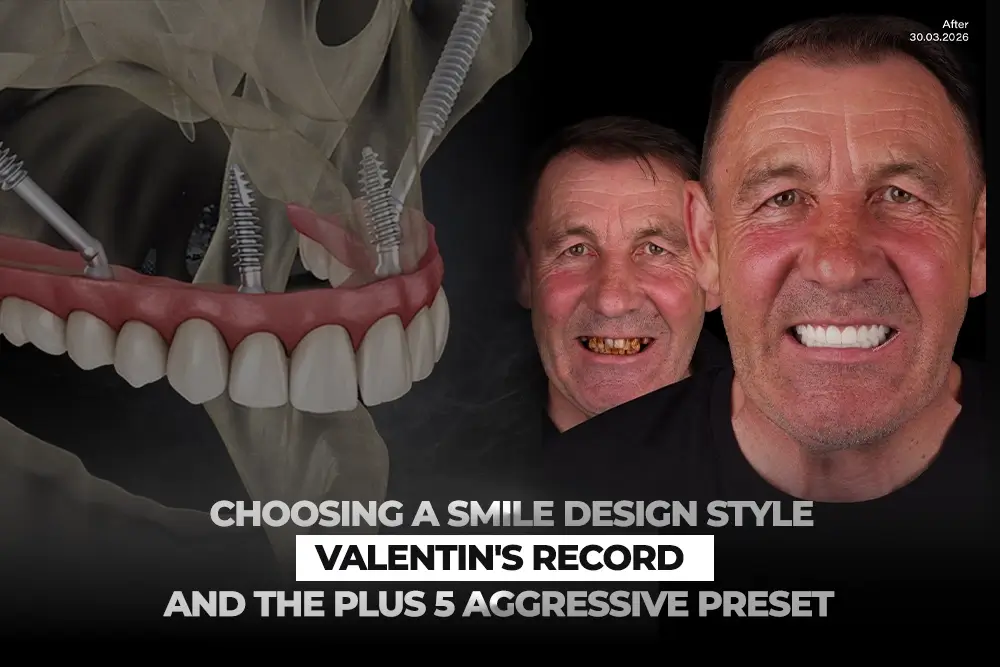
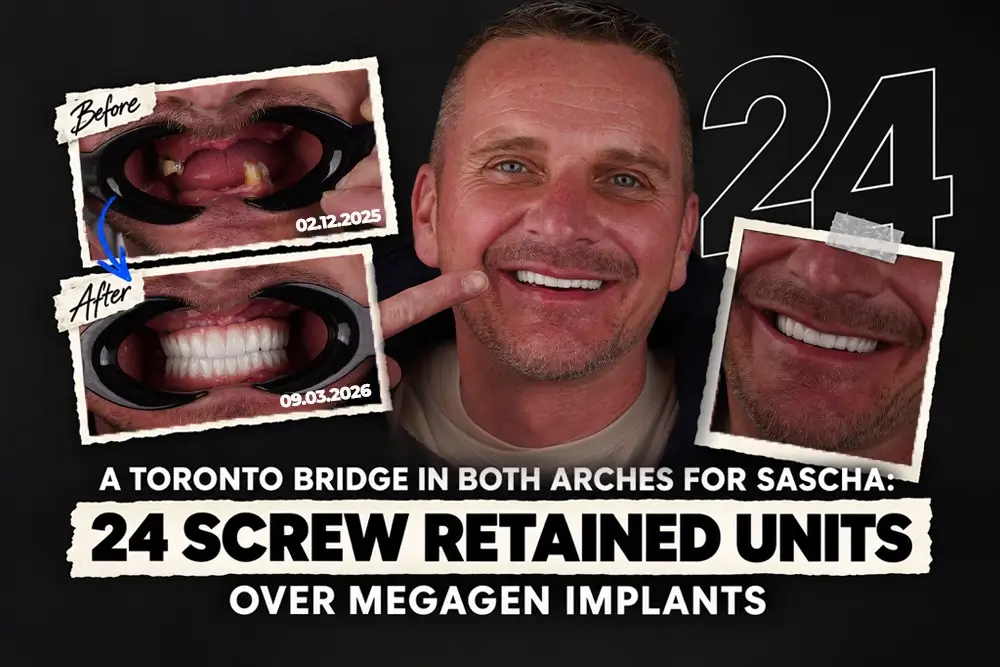
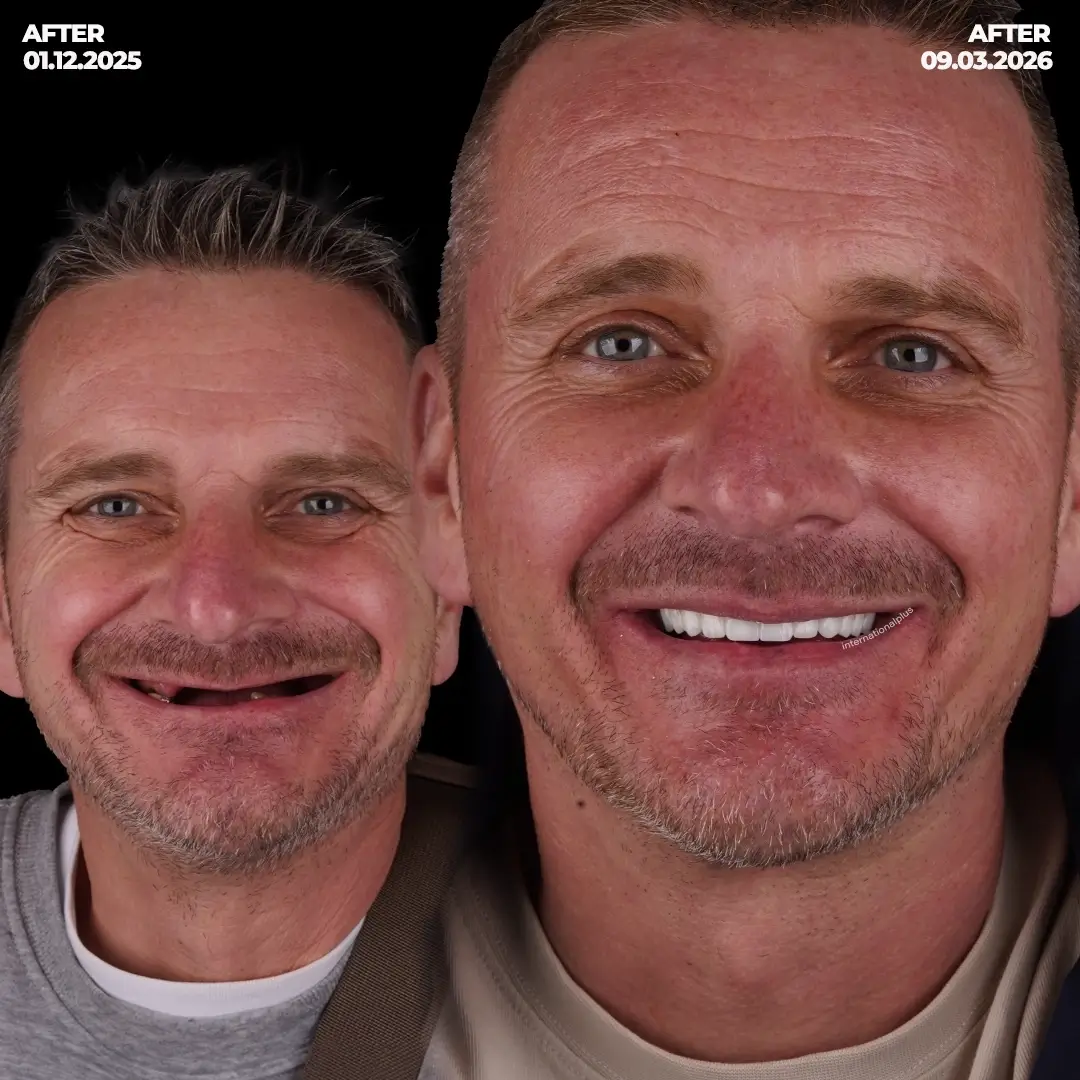
A toronto bridge both arches plan is a different problem from the same design in one jaw. Sascha was treated at International Plus as a German speaking patient and the record lists a Toronto bridge above and below, 24 screw retained zirconia units, Megagen implants and shade Om3. When both jaws are rebuilt at once there is no original bite left to copy. This case study follows what that means.
Key Takeaways
- The challenge: Rebuilding the upper and lower jaw together with no untouched arch left as a reference.
- The solution: A Toronto bridge design in both arches carrying 24 screw retained zirconia units over Megagen implants.
- The technique: Face scanning and a recorded polish stage with shade Om3 and the clinic’s Plus 5 smile design style.
- The outcome: 24 units delivered with a night guard fitted at the same appointment.
What a Toronto Bridge Is
A Toronto bridge is a fixed full arch restoration carried on a rigid framework that is screwed onto several implants rather than resting on gum tissue. The patient does not remove it.
The screw fixing is central to the design. A systematic review compared the clinical performance of screw retained against cement retained implant reconstructions (Wittneben JG, et al., 2014) and a meta-analysis examined marginal bone loss across the same comparison (Lemos CA, et al., 2016).
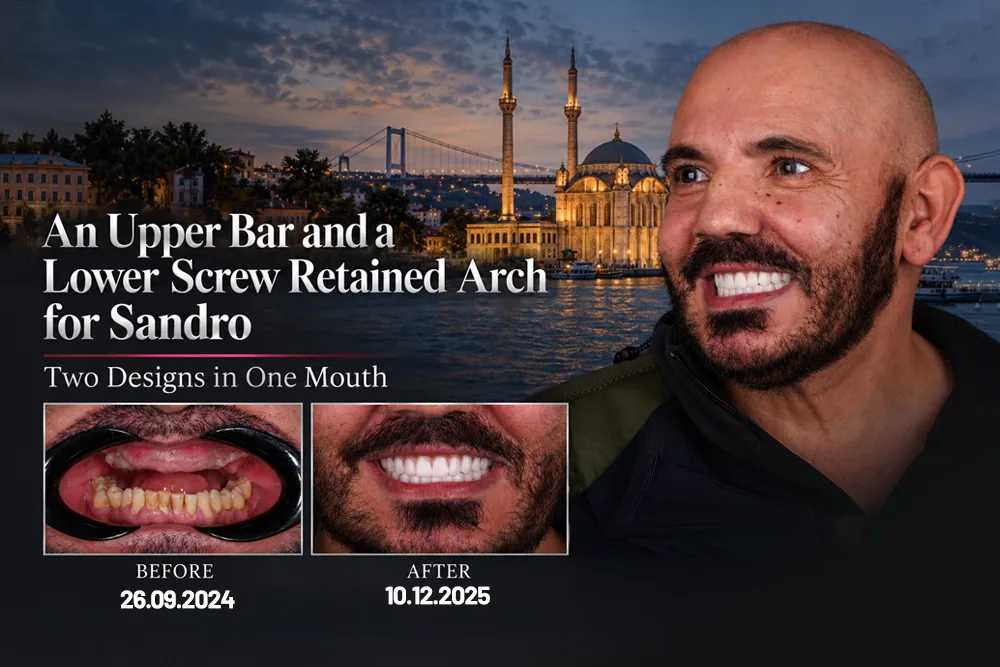
Sascha’s record lists the design in both jaws. For example, our two design case records a different arrangement where the two arches were not given matching designs. Treatment of this kind sits under dental implant.
Sascha’s Record and the Two Arch Design
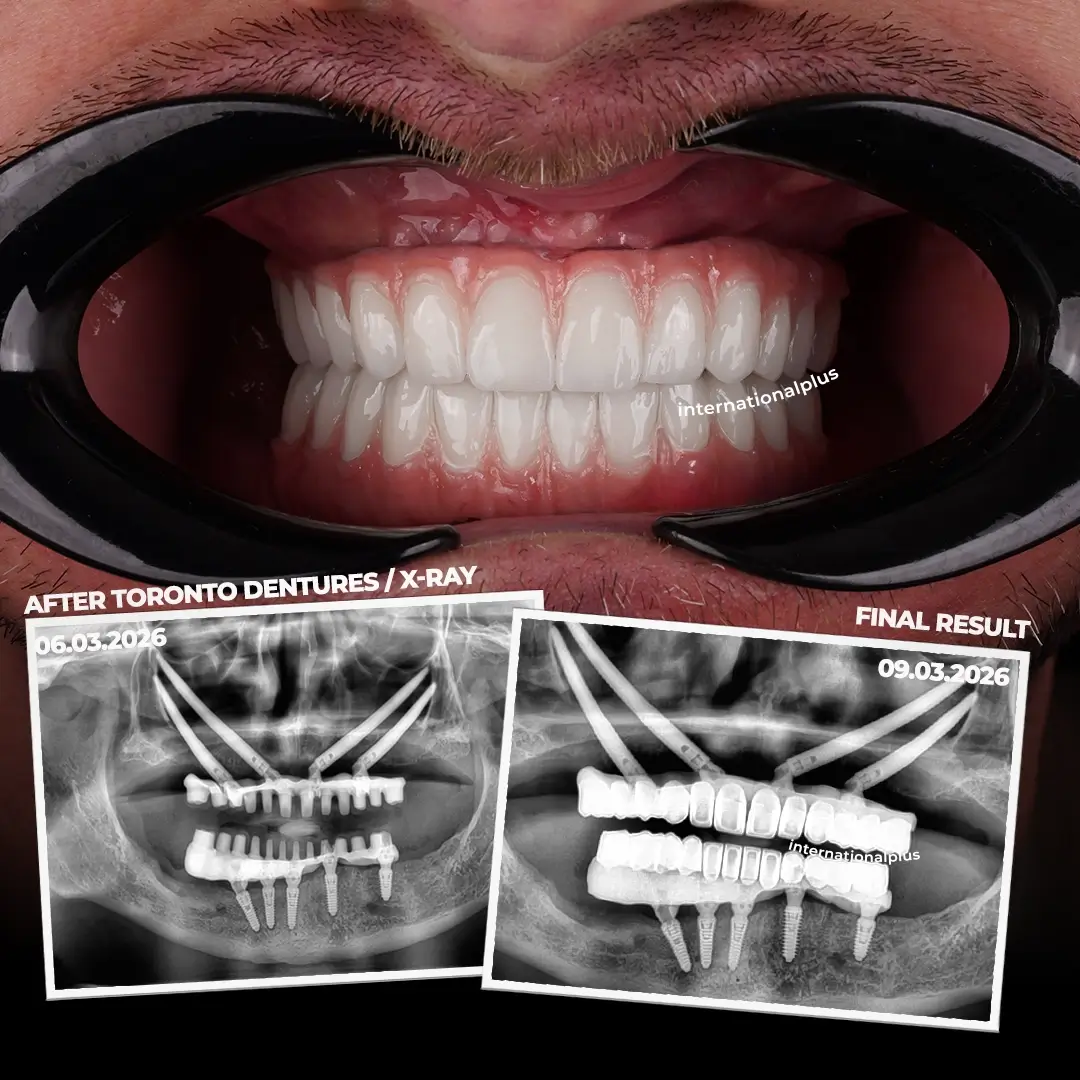
The file lists Toronto above and below with 24 zirconia units recorded as screw retained. A framework is the rigid structure the units sit on and the record lists the design for both jaws.
Megagen is named as the implant system and the shade reads Om3. A face scan, a polish stage and photography are each recorded separately, alongside the Plus 5 smile design style. A night guard closes the plan.
According to systematic reviews of implant supported reconstructions, retention method carries consequences for both complications and later maintenance (Wittneben JG, et al., 2014). For example, writing the design, the system and the retention as three entries lets a clinician read the sequence rather than a summary.
| Record | Detail |
|—|—|
| Design | Toronto bridge, upper and lower |
| Zirconia units | 24, screw retained |
| Implant system | Megagen |
| Shade | Om3 |
| Smile design style | Plus 5 |
| Recorded stages | Face scan, polish stage, photography |
| Appliance | Night guard fitted at delivery |
Why Two Arches at Once Is the Harder Case
When one jaw is restored, the opposing arch stays as a reference. A reference arch is an untreated jaw whose existing tooth positions the new work can be matched against and rebuilding both removes it.
A systematic review has examined the value of an evaluation phase before an altered bite is made permanent (Chantler J, et al., 2025). Related work has reviewed the assumptions clinicians carry about vertical dimension in restorative practice (Lassmann Ł, et al., 2025).
Rebuilding both jaws together costs a longer verification stage but the trade is common on two arch plans because leaving one arch untreated would fix the new design to an old reference. In practice our clinic records the face scan as part of that verification, a stage planned as digital smile design.
The 24 Screw Retained Units
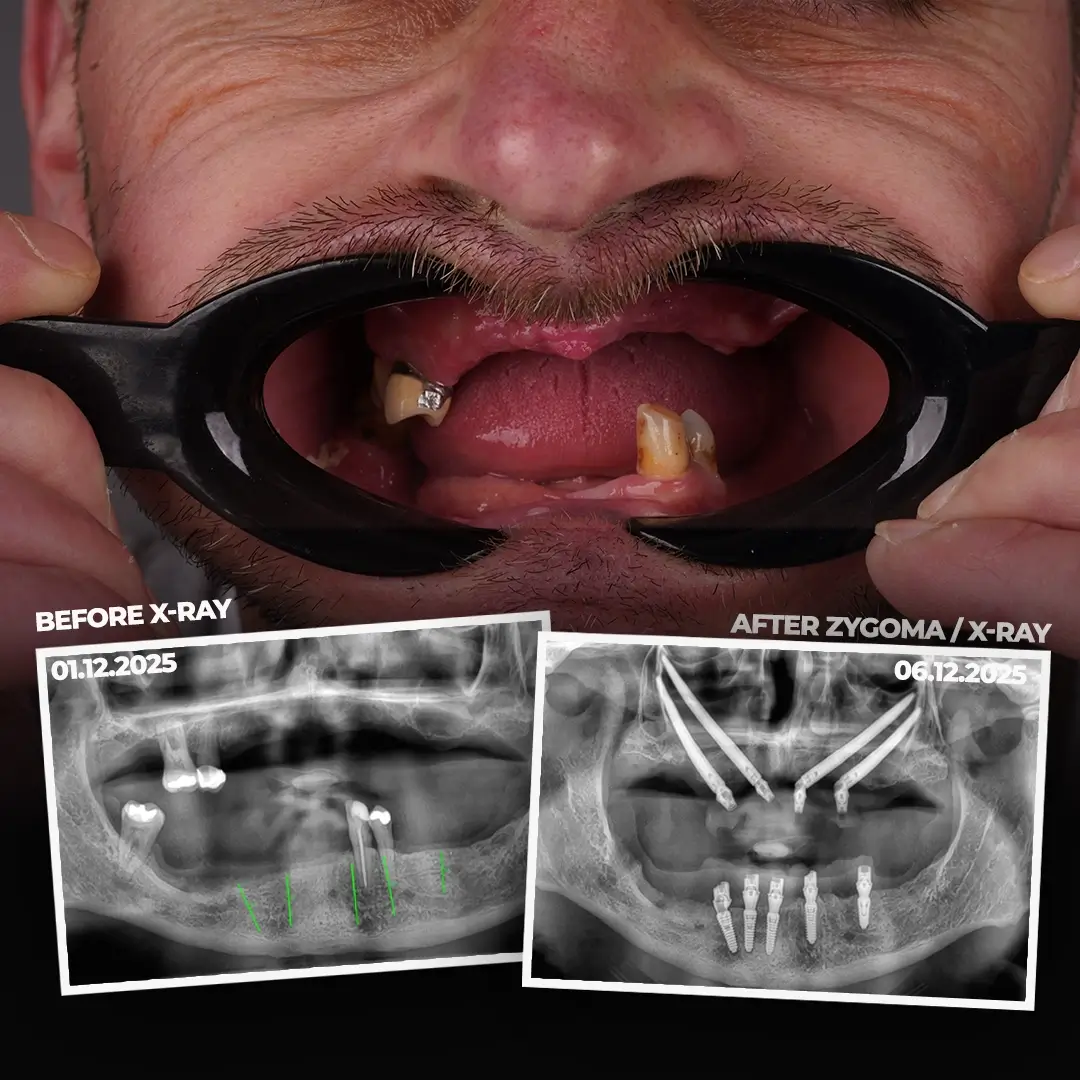
Twenty four units spread across two Toronto frameworks. Screw retention on this design means the framework itself is fixed to the implants with screws that can be released so the restoration is lifted as one piece rather than cemented permanently in place.
Retrievability costs an access channel in the biting surface but that channel is accepted on designs of this size because a framework held by screws can be lifted for servicing without being destroyed. Prosthetic design has been examined against peri-implant outcomes in a systematic review and meta-analysis (Lin GH, et al., 2025).
Production ran in the clinic’s own digital laboratory. Comparable full arch work with other framework choices appears in our bar supported rehabilitation case and our implant supported zirconia bridge case.
What the Record Shows at Delivery
Sascha’s file documents a Toronto design in both jaws, 24 screw retained units, Megagen implants, shade Om3, a face scan, a polish stage, photography and a night guard fitted at delivery.
That level of detail is what a clinician servicing the work needs. Knowing the framework design, the implant system and the retention method tells a clinician whether a future problem can be approached by releasing a screw. Our clinic issues those details in writing.
This is one patient’s recorded outcome and individual results may vary. International Plus has treated more than 200,000 patients from 140+ countries since 2014 and holds a rating of 4.8 out of 5 across 5,504 reviews. No clinic can promise an identical plan because a jaw that supports a Toronto framework in one patient may not in another.
Book a consultation with International Plus if you want to know whether a Toronto design suits your own jaws.
Frequently Asked Questions
What is a Toronto bridge?
A Toronto bridge is a fixed full arch restoration carried on a rigid framework screwed onto several implants rather than resting on gum tissue. The patient does not remove it. The screw fixing allows the whole framework to be lifted for servicing without being cut off the implants.
Is a Toronto bridge in both jaws different from one jaw?
Yes because restoring one arch leaves the opposing arch as a reference while restoring both removes it. The relationship between the jaws is then established rather than matched, which lengthens the verification stage before anything is made permanent.
What does screw retained mean on a Toronto bridge?
The framework is fixed to the implants with screws passing through access channels rather than with cement. Those screws can be released so the restoration is retrievable as one piece. On a design spanning a whole arch that matters because a cemented framework would have to be destroyed to remove it.
Why are face scanning and photography recorded separately?
They answer different questions. A face scan captures proportion against facial landmarks for the design stage while photography documents the record at a point in time. Listing them as separate entries means each can be traced back to the appointment where it was taken.
How long does a Toronto bridge in both arches last?
Longevity depends on the implants, the framework, the bite and daily maintenance rather than on the design alone. Research has examined prosthetic design against peri-implant outcomes. A night guard is recorded in this file.
Reviewed by Dr. Hüseyin Baluken
References
- Wittneben JG, et al. Int J Oral Maxillofac Implants. 2014. PMID: 24660192
- Lemos CA, et al. J Prosthet Dent. 2016. PMID: 26589441
- Chantler J, et al. J Esthet Restor Dent. 2025. PMC12076109
- Lassmann Ł, et al. J Esthet Restor Dent. 2025. PMID: 39189329
- Lin GH, et al. J Periodontol. 2025. PMC12273757
Follow us on Social Media
internationalplusofficial
internationalplus
internationalplusdental
This content is written, reviewed, and approved by the International Plus Medical Review Board to ensure clinical accuracy and adherence to strict editorial standards. All medical information is regularly monitored, audited and updated in light of the latest scientific advancements.
However the information provided here is for general informational purposes only and cannot be used for self diagnosis or making individual health interpretations. Results of medical treatments depend on individual anatomy and the unique healing process of each patient. This information should not replace a personal consultation with a qualified healthcare professional. To understand the best options for your specific needs and to receive a personalized treatment plan, we invite you to book a free consultation with the expert medical team at International Plus.
Dr. Emre Çolak concentrates on advanced implant surgery and modern regenerative treatments, delivering refined solutions to patients abroad in need of complex dental restoration.