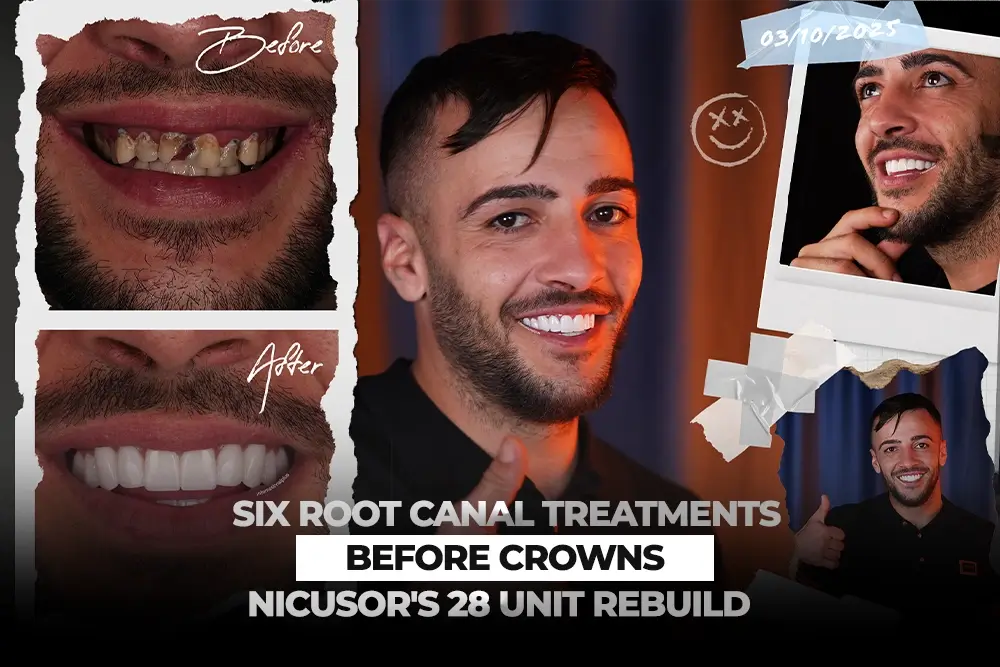
Six root canal treatments before crowns is a volume of endodontic work that changes a treatment plan rather than sitting inside it. Nicusor was treated at International Plus as a Romanian speaking patient whose record lists 6 root canal treatments alongside 28 zirconia units, BEGO implants and a face scan. The record keeps those entries separate. This case study follows what that volume of endodontic work involves.
Key Takeaways
- The challenge: A record listing 6 separate root canal treatments alongside a 28 unit two arch rebuild.
- The solution: The endodontic work recorded as its own category with 28 zirconia units designed as a single set.
- The technique: Shade OM2 with the clinic’s Plus 5 smile design style, recorded with a face scan.
- The outcome: 28 units delivered with a night guard fitted at the same appointment.
Why Endodontic Volume Changes a Plan
A single root canal treatment fits inside an appointment. Six of them form a stage with its own sequence because each tooth is assessed separately before the restorative work above it is designed.
Endodontic treatment is a procedure that removes the pulp from inside a tooth and seals the canal space. Outcome research has characterised what distinguishes a successful result from an unsuccessful one (Estrela C, et al., 2014). A treated tooth is therefore checked rather than assumed sound.
Volume changes the timetable rather than the technique. For example, 6 treated teeth produce 6 separate assessments before a single crown is designed and our clinic records each one in the file. The principle on a smaller plan is set out in our root canal before crown case and treatment of this kind sits under endodontics.
Nicusor’s Record and the Order of Work
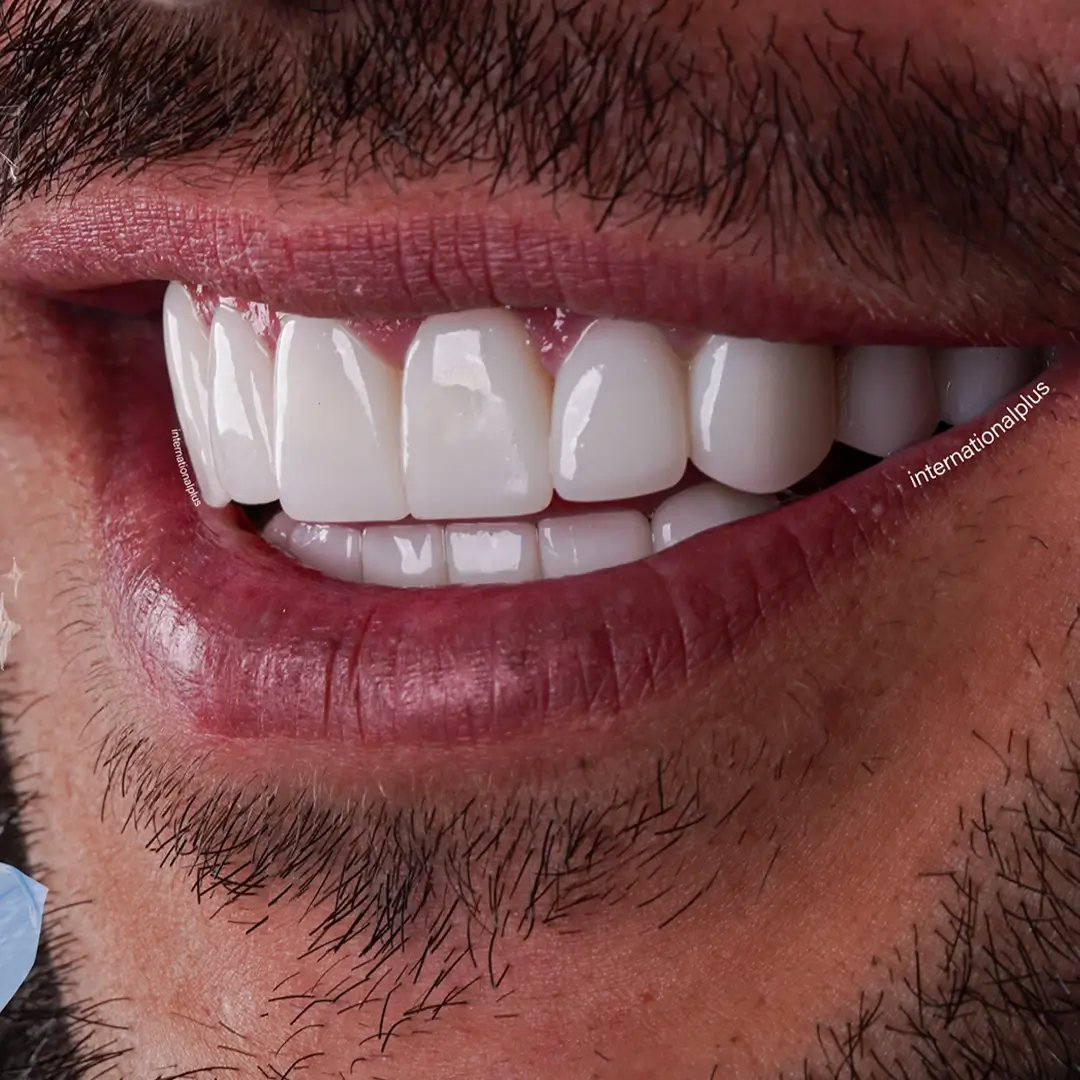
The file lists four categories: 6 root canal treatments, 28 zirconia units, BEGO implants and a face scan. A record category is a group of work written as its own entry rather than folded into a description.
Recording them separately is what allows the order to be read afterwards. The endodontic work sits before the restorative work and the shade and design style were set before production began.
Long term evaluation of extensive tooth supported prostheses has reported how such restorations behave over a decade (Alsterstål-Englund H, et al., 2021). For example, our clinic groups the endodontic entries as one category in the file rather than scattering them through the plan.
| Record | Detail |
|—|—|
| Root canal treatments | 6 |
| Zirconia units | 28 |
| Implant system | BEGO |
| Shade | OM2 |
| Smile design style | Plus 5 |
| Digital record | Face scan |
| Appliance | Night guard fitted at delivery |
| Language | Patient treated in Romanian |
How a Treated Tooth Behaves as an Abutment
An abutment is a prepared tooth that carries a crown. A tooth that has had root canal treatment carries one differently from an untreated tooth because the pulp chamber is emptied and the remaining walls are thinner.
A systematic review and meta-analysis has examined outcomes for endodontically treated teeth with structural compromise (Leong DJX, et al., 2020). Separate long term work has evaluated extensive tooth supported fixed prostheses over a decade (Alsterstål-Englund H, et al., 2021).
Treating a tooth first adds appointments to a plan but that order is common because reaching a canal through a finished crown is harder than reaching it before. Patients comparing restoration types will find the background in our guide to what a dental crown is.

The 28 Units in the Restorative Phase
Twenty eight units covers every tooth position in both arches once third molars are excluded. The file names a BEGO implant system alongside the 6 endodontically treated teeth without assigning units to either.
Clinical performance of monolithic CAD/CAM zirconia has been reviewed systematically (Leitão CIMB, et al., 2022), which is the material class recorded for this case.
Shade OM2 and the Plus 5 style were recorded before milling, a planning stage offered as digital smile design. Milling took place in the clinic’s own digital laboratory. A comparable two arch plan with a different preparatory stage is documented in our 28 unit zirconia bridge case.
What the Record Shows at Delivery
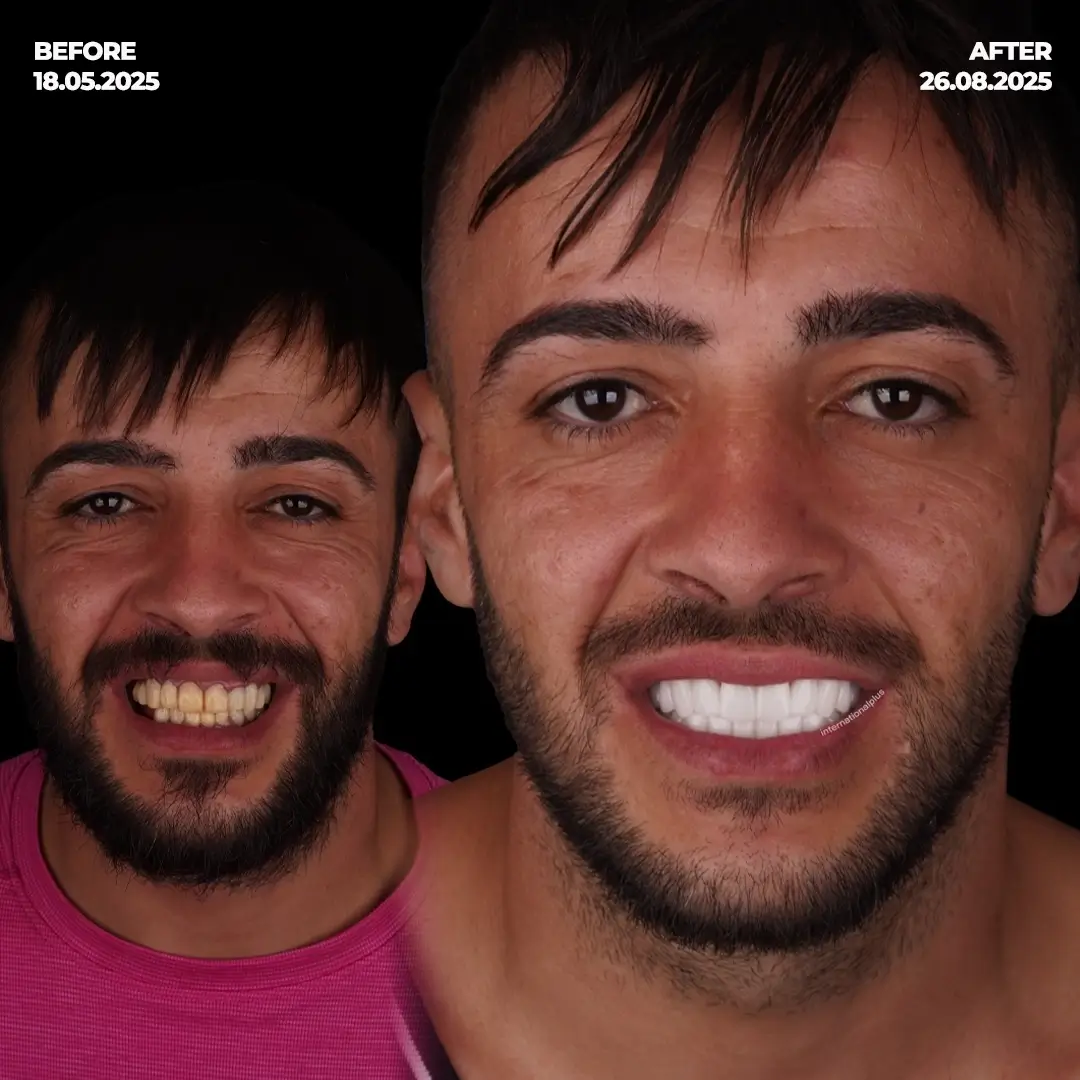
Nicusor’s file documents 6 root canal treatments, 28 zirconia units, a BEGO implant system, a face scan and a night guard fitted at delivery. Each entry is written separately rather than summarised.
That separation is what makes the file useful to a clinician years later. A record naming the endodontic work separately changes how a later problem beneath a crown is investigated. Our clinic issues a written record of the systems and materials used.
This is one patient’s recorded outcome and individual results may vary. International Plus has treated more than 200,000 patients from 140+ countries since 2014 and holds a rating of 4.8 out of 5 across 5,504 reviews. No clinic can promise the same sequence since the number of teeth needing endodontic work differs in every mouth.
Book a consultation with International Plus if you want to know how much preparatory work your own case would need.
Frequently Asked Questions
Why are root canal treatments done before crowns?
A tooth is generally assessed as sound and symptom free before it carries a crown. Reaching the canal afterwards means drilling through a finished restoration, which risks the crown and adds cost. Completing the endodontic work first also reveals a tooth that turns out to be unrestorable.
Does six root canal treatments mean the case took longer?
Endodontic volume affects the timetable because each tooth is assessed separately rather than as a batch. Six treatments form a stage with its own sequence ahead of the restorative work. The exact number of appointments depends on how the individual teeth respond rather than on the total alone.
Can a root canal treated tooth carry a crown?
Yes and it is routine. The tooth behaves differently from an untreated one because the pulp chamber is emptied and the remaining walls are thinner. That difference is assessed before the restoration is designed and reviews have examined outcomes for endodontically treated teeth under load.
What does the face scan contribute to this kind of plan?
A face scan records the smile in the context of the whole face rather than on a model. Proportion is judged against facial landmarks such as the midline and the lip line. The scan gives the laboratory a reference that an intraoral impression on its own does not provide.
Why is a night guard part of the plan?
A night guard is an appliance worn during sleep that takes night time loading. With 28 units delivered at once, that loading falls across a large volume of new restorative work. The record lists the guard fitted at delivery rather than at a later appointment.
Reviewed by Dr. Eren Gülbahar
References
- Estrela C, et al. Braz Dent J. 2014. PMID: 24789284
- Leong DJX, et al. Clin Oral Investig. 2020. PMID: 31797172
- Alsterstål-Englund H, et al. J Prosthet Dent. 2021. PMID: 32059857
- Leitão CIMB, et al. J Prosthodont Res. 2022. PMID: 34615842
Follow us on Social Media
internationalplusofficial
internationalplus
internationalplusdental
This content is written, reviewed, and approved by the International Plus Medical Review Board to ensure clinical accuracy and adherence to strict editorial standards. All medical information is regularly monitored, audited and updated in light of the latest scientific advancements.
However the information provided here is for general informational purposes only and cannot be used for self diagnosis or making individual health interpretations. Results of medical treatments depend on individual anatomy and the unique healing process of each patient. This information should not replace a personal consultation with a qualified healthcare professional. To understand the best options for your specific needs and to receive a personalized treatment plan, we invite you to book a free consultation with the expert medical team at International Plus.

I am a healthcare professional with over 4 years of experience in dentistry, specializing in prosthetic dental treatment and implant-based applications. Since 2024, I have been serving as chief physician, leading clinical management, team coordination, and international patient processes. With my B2-level English proficiency, I am able to communicate effectively with international patients. I am a patient-centered, innovative, and solution-oriented dentist who prioritizes patient satisfaction.