Canker sores are small, shallow ulcers inside the mouth that hurt far more than their size suggests. This guide explains what causes them, how they differ from cold sores, how long healing takes and which signs need a dental exam. Authorized by the Turkish Ministry of Health and rated 4.8/5 across 5,504+ verified reviews, International Plus has assessed oral mucosal complaints for patients from over 140 countries.
Key Takeaways
- Canker sores form inside the mouth on soft movable tissue and no virus is involved so they do not spread from person to person.
- Cold sores are the opposite case: herpes simplex virus causes them, they sit on the lip border and they are contagious.
- Most minor canker sores heal without scarring in 7 to 14 days and treatment aims at pain relief rather than a cure.
- Recurring outbreaks sometimes point to iron, folate or vitamin B12 deficiency, which a blood test can identify.
- A mouth ulcer that lasts longer than two weeks, keeps growing or has raised borders needs professional evaluation.
What Are Canker Sores?
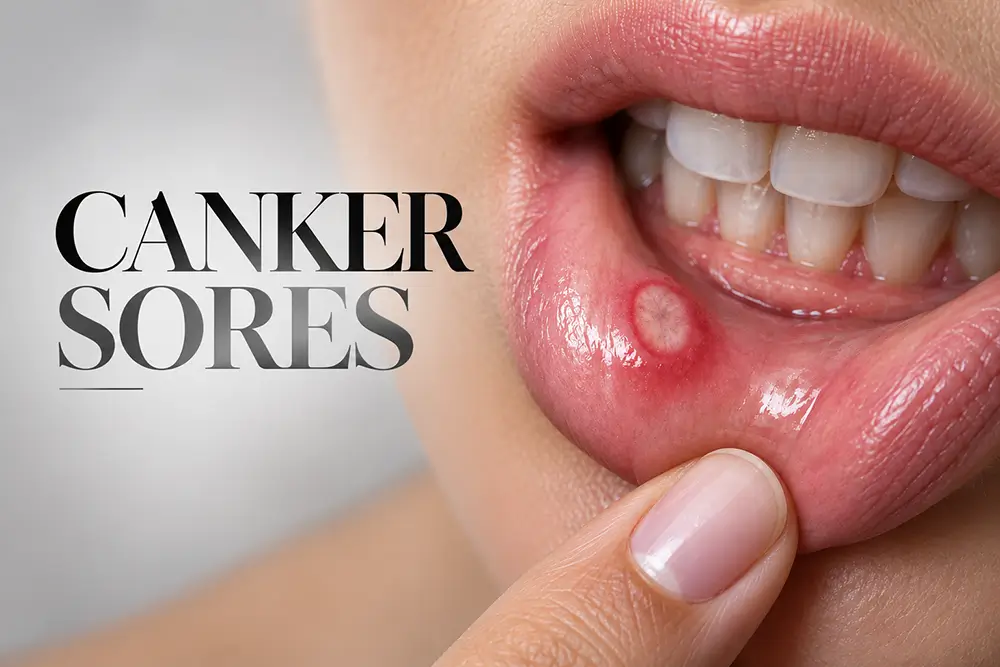
A canker sore is a shallow ulcer of the oral mucosa with a white or yellow floor and a red halo around it. The medical name is recurrent aphthous stomatitis. Aphthous ulcers appear on loose tissue such as the inner lip, cheek lining, tongue or floor of the mouth.
Three clinical forms are recognised. Minor aphthae measure under 10 mm and account for roughly 80 percent of cases, healing in 7 to 14 days without scarring. Major aphthae are larger than 10 mm and reach deeper tissue so closure can take several weeks and sometimes leaves a scar. Herpetiform ulcers arrive as dozens of pinpoint lesions that merge into a raw patch yet no herpes virus is involved despite the name (Stoopler ET, et al., 2024; Akintoye SO, et al., 2014). Around 20 percent of the general population experiences aphthous ulceration at some point (Manfredini M, et al., 2021). Knowing which form is present shapes how long a patient should expect to wait.
Canker Sore vs Cold Sore: How to Tell the Difference
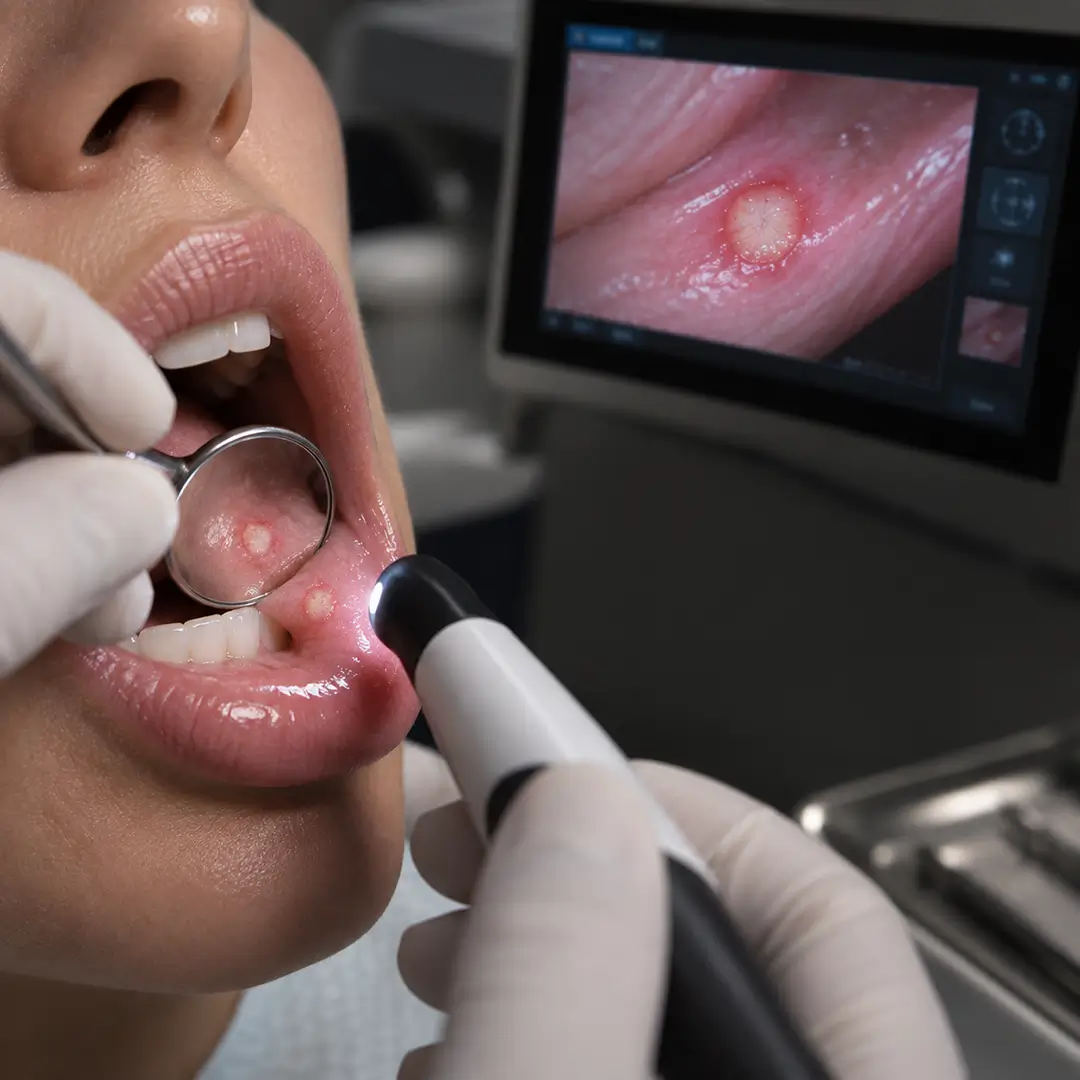
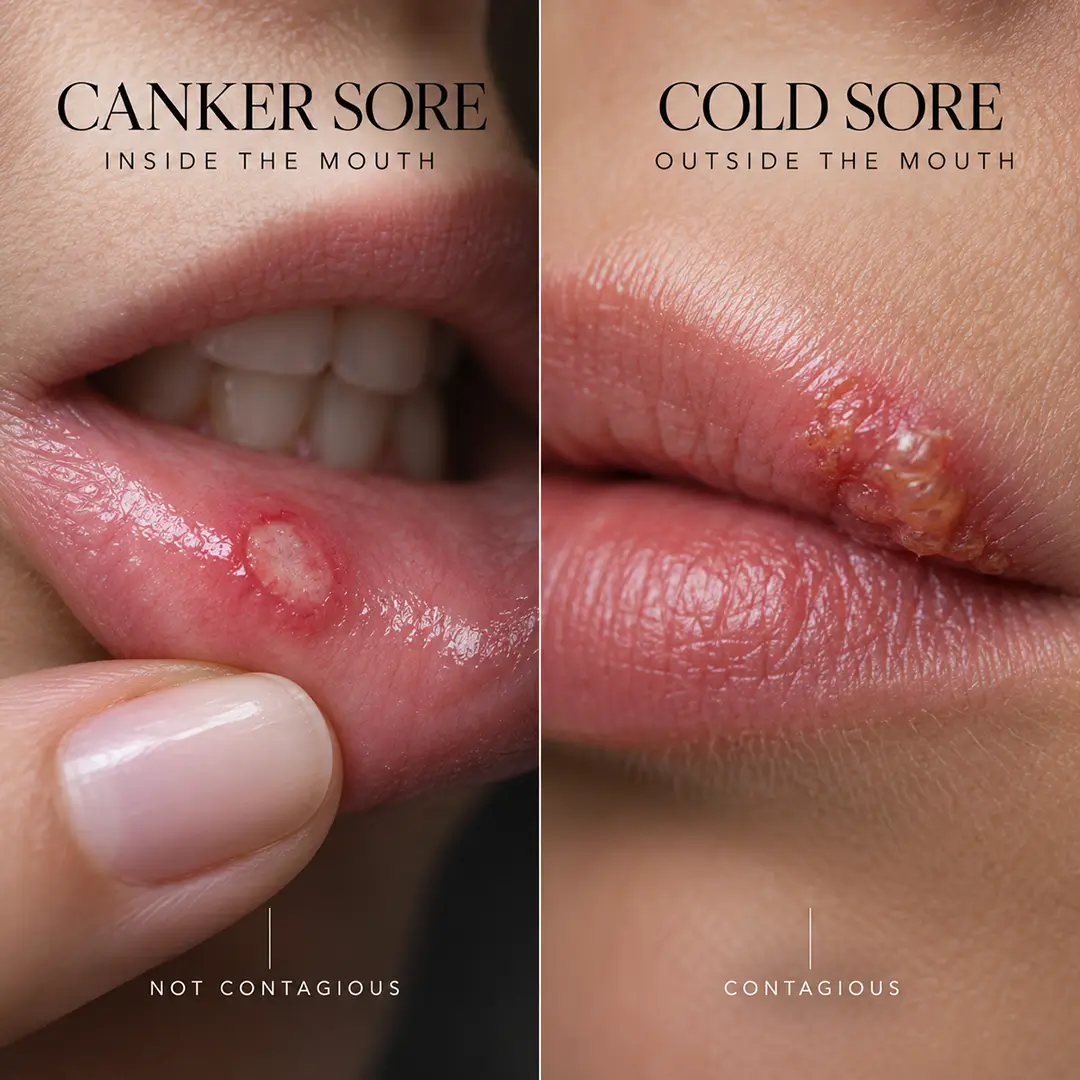
The single clearest test is location. Canker sores sit inside the mouth on soft tissue and are not contagious. Cold sores sit on the lip border or the skin around the mouth. Each lesion begins as a fluid filled blister caused by herpes simplex virus and direct contact spreads it.
Confusing the two leads to the wrong care. Antiviral creams sold for cold sores do nothing for an aphthous ulcer while a patient who assumes a lip blister is harmless can pass herpes simplex to a partner or child. Cold sores typically begin with a tingling warning 12 to 24 hours before the blister appears, then crust over within about 8 to 10 days (Spencer GW, et al., 2020). In our Istanbul clinic the Diagnostic Council records lesion site and border character at the first visit because that pair of findings separates the two conditions faster than any symptom description.
| Feature | Canker sore (aphthous ulcer) | Cold sore (herpes labialis) |
| Location | Inside the mouth on soft movable tissue | Lip border, outer lip, skin near the mouth |
| Cause | Local immune reaction, no virus | Herpes simplex virus |
| Contagious | No | Yes through direct contact |
| Appearance | Flat ulcer, white or yellow floor, red rim | Cluster of blisters that crust over |
| Warning sign before | Mild soreness at the site | Tingling 12 to 24 hours earlier |
The table gives the practical rule: inside the mouth and flat points to a canker sore on the lip and blistered points to a cold sore.
What Causes Canker Sores and How Canker Sores Form
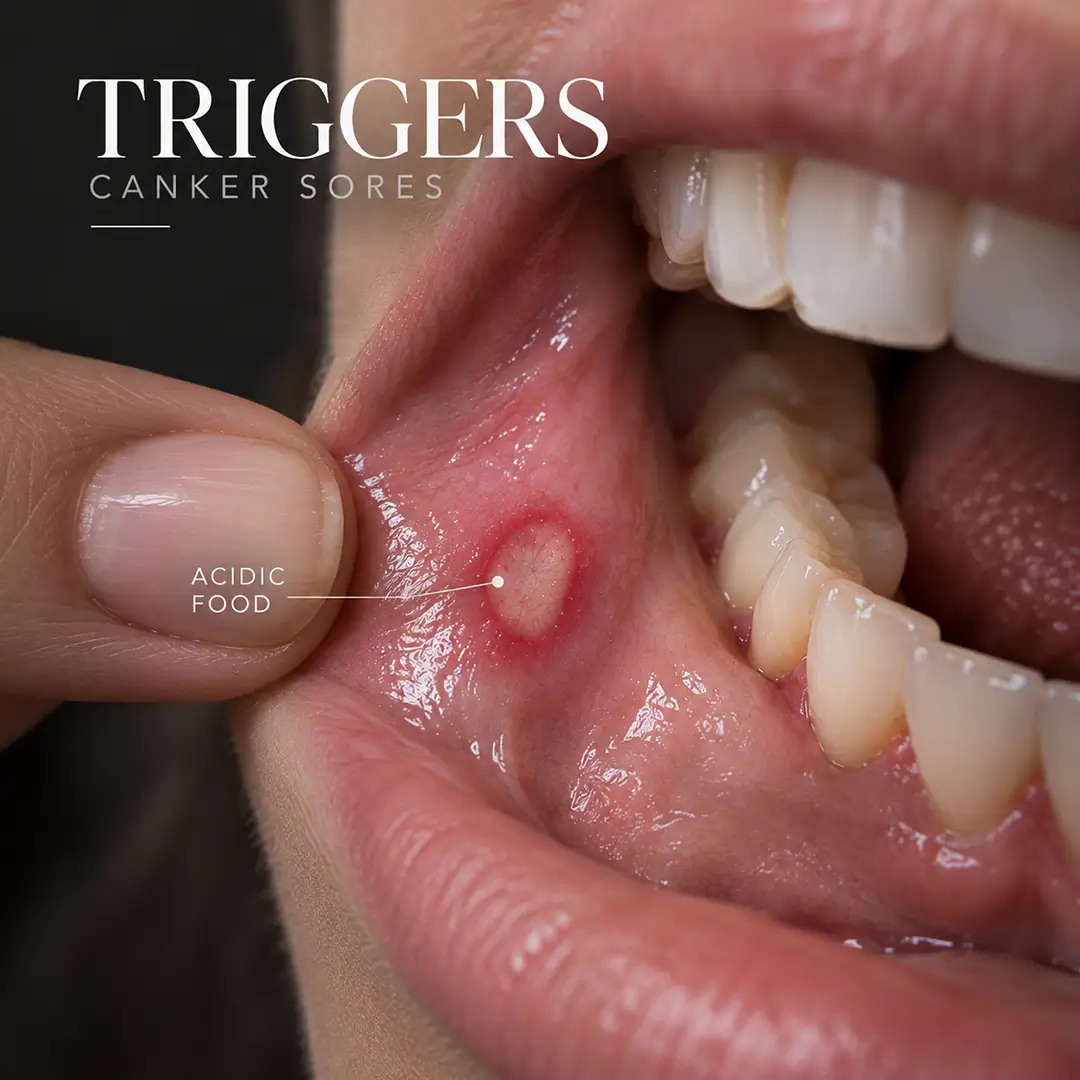
No single organism causes canker sores. Formation begins when a local trigger provokes a T cell driven immune response in the mucosa. The surface then breaks down into an ulcer crater. Frequent triggers include minor injury, acidic food, emotional stress, hormonal shifts or toothpaste containing sodium lauryl sulfate.
Injury is the trigger patients recognise most often. A toothbrush slip, a sharp filling edge, an orthodontic bracket or an accidental cheek bite starts the process within a day or two (Lau CB, et al., 2022). Citrus fruit, tomato, pineapple or vinegar based dressings irritate an already thin mucosa. Genetics matter as well since roughly 40 percent of affected patients report a parent or sibling with the same pattern (Manfredini M, et al., 2021). A rough tooth surface deserves attention here because a chipped tooth with a sharp edge can seed a new ulcer every few weeks until the edge is smoothed.
Book Your Free Consultation →
Why Do I Keep Getting Canker Sores?
Repeated outbreaks usually mean a trigger is still present or an underlying deficiency is feeding the cycle. Iron, folate or vitamin B12 shortfalls turn up in a meaningful minority of patients with frequent ulcers and correcting a confirmed deficiency reduces how often new lesions appear.
A blood test separates guesswork from evidence. In a controlled series, patients with recurrent ulcers showed significantly higher rates of low serum iron, low folate or low vitamin B12 than healthy controls (Sun A, et al., 2015). Coeliac disease, inflammatory bowel disease or Behçet disease also present with mouth ulcers, which is why a physician referral belongs in the plan when ulcers arrive monthly (Sánchez-Bernal J, et al., 2020). Reduced saliva raises the risk too so patients dealing with dry mouth tend to report longer and more painful episodes. Supplementing without a test result wastes money and hides the real cause.
How Long Do Canker Sores Last?
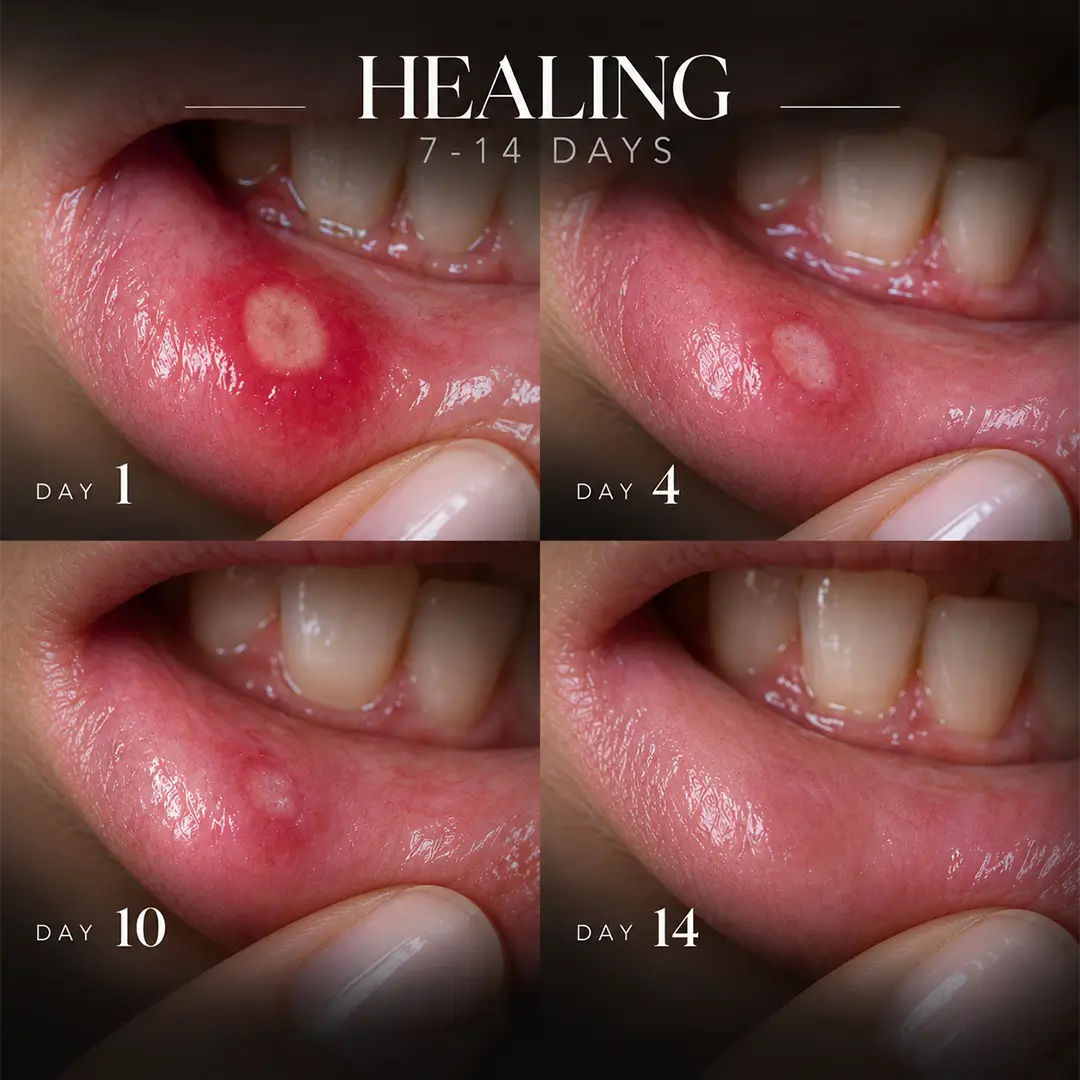
Minor canker sores heal in 7 to 14 days without treatment and without scarring. Major aphthae need 2 to 6 weeks and can leave a scar. Herpetiform ulcers usually resolve within 2 weeks. Pain peaks in the first 3 to 4 days, then fades well before the ulcer closes.
Healing follows a predictable sequence. The floor of a minor ulcer turns from yellow grey to pink as new epithelium creeps in from the rim and eating becomes comfortable several days before the crater disappears. Treatment shortens discomfort rather than the biological timetable (Stoopler ET, et al., 2024). Our clinicians ask patients to photograph the lesion on day 1 and day 10 because a sore that has not visibly shrunk by the tenth day belongs in a different diagnostic category and needs an appointment rather than another week of mouth rinse.
How to Get Rid of Canker Sores Fast
Nothing removes a canker sore overnight. Faster comfort comes from protecting the ulcer and removing the irritant: rinse with warm salt water, switch to a toothpaste free of sodium lauryl sulfate, avoid acidic or crunchy food, then clean gently around the area with a soft brush.
Evidence supports symptom control rather than cure. Topical anaesthetic and anti inflammatory preparations reduce pain scores and let patients eat normally and a dentist selects the right formulation after examining the site (Lau CB, et al., 2022). Salt water rinsing works well for a fresh minor ulcer but it is not suitable for a large major aphtha because the crater keeps reopening while the underlying trigger stays untreated. Hydrogen peroxide and undiluted home remedies burn healthy mucosa and delay closure. Patients troubled by bad breath during an outbreak should keep brushing gently rather than stopping since plaque build up prolongs inflammation. Prescription decisions belong to a clinician who has seen the lesion.
Canker Sores on the Tongue, Lips and Inner Cheek
Location changes how much a canker sore hurts. Ulcers on the tongue and floor of the mouth are the most painful because those surfaces move constantly during speech and swallowing. Inner cheek and lower lip lesions are the most common and both sites take the same 7 to 14 days to heal.
Site also hints at the trigger. A recurring ulcer on the same spot of the inner cheek points to a mechanical cause such as a sharp cusp or an ill fitting restoration and smoothing that surface ends the cycle. Tongue lesions frequently follow a spicy or acidic meal. Ulcers near the gum margin can be mistaken for gum inflammation so patients who also notice swelling or bleeding should read our guide to gum disease and have the tissue examined. When pain radiates into a tooth rather than staying in the soft tissue, the source is usually dental instead. Our page on tooth pain relief explains that distinction.
Get a personalized assessment from our dental team →
When to See a Doctor About a Canker Sore
Book an examination when a mouth ulcer lasts longer than two weeks, keeps enlarging, measures more than 10 mm, has raised or hardened borders or returns more than six times a year. Fever, difficulty swallowing or ulcers appearing on the genitals or eyes also warrant prompt medical review.
These rules exist because several conditions imitate an ordinary aphthous ulcer. A persistent single ulcer with a hardened edge requires biopsy to exclude malignancy and clinical guidance is consistent that the two week mark is the trigger for referral rather than a reason for alarm (Sánchez-Bernal J, et al., 2020). Dental infection can also produce a draining sore that looks superficial, which our page on tooth infection describes in detail. At International Plus, ulcers linked to inflamed tissue are reviewed alongside gum disease treatment and periodontal care while a sore traced to a dying nerve is referred for root canal treatment by endodontic specialists. With 200,000+ patients treated from 140+ countries, our team screens every soft tissue lesion at the first appointment rather than treating it as an afterthought.
Schedule an oral health check at International Plus →
Frequently Asked Questions
Are canker sores contagious?
No. An aphthous ulcer is not caused by a virus or bacteria that passes between people so kissing, sharing cutlery or drinking from the same glass will not transmit it. The contagious lesion people confuse it with is the cold sore. That blister comes from herpes simplex virus and sits on the lip.
Are canker sores herpes?
No, canker sores are not herpes. Herpes simplex virus causes cold sores on the lip border and the skin around the mouth. An aphthous ulcer develops on soft tissue inside the mouth through a local immune reaction with no virus involved. The herpetiform subtype has a misleading name but no viral cause.
How do you get rid of canker sores fast?
Nothing clears a canker sore overnight. Rinsing with warm salt water, avoiding acidic or crunchy food, switching to toothpaste free of sodium lauryl sulfate and using a soft brush all reduce pain within a day or two. A dentist can prescribe a topical preparation when eating remains difficult.
What causes canker sores in your mouth?
An immune reaction in the mucosa creates the ulcer, usually after a trigger. Minor injury from brushing or a sharp tooth edge, acidic food, stress, hormonal changes or sodium lauryl sulfate in toothpaste are the frequent culprits. Iron, folate or vitamin B12 deficiency drives repeated outbreaks in some patients.
How long do canker sores last?
Minor canker sores heal in 7 to 14 days and leave no scar. Major ulcers larger than 10 mm need 2 to 6 weeks and may scar. Pain is worst during the first 3 to 4 days. An ulcer still present after two weeks needs a professional examination.
Why do I keep getting canker sores?
Repeated outbreaks point either to an unresolved local irritant, such as a sharp restoration or to an underlying issue. Blood tests can reveal low iron, low folate or low vitamin B12. Coeliac disease, inflammatory bowel disease or Behçet disease also cause recurrent mouth ulcers and deserve medical assessment.
Reviewed by Dr. Emre Çolak
References
- Stoopler ET, et al. JAMA. 2024. PMID: 38530258
- Lau CB, et al. Dermatol Ther. 2022. PMID: 35395126
- Manfredini M, et al. Dermatol Pract Concept. 2021. PMC8480451
- Akintoye SO, et al. Dent Clin North Am. 2014. PMC3964366
- Sun A, et al. J Oral Pathol Med. 2015. PMID: 25048341
- Spencer GW, et al. J Am Dent Assoc. 2020. PMID: 33228880
- Sánchez-Bernal J, et al. Actas Dermosifiliogr. 2020. PMID: 32451064
Follow us on Social Media
internationalplusofficial
internationalplus
internationalplusdental
This content is written, reviewed, and approved by the International Plus Medical Review Board to ensure clinical accuracy and adherence to strict editorial standards. All medical information is regularly monitored, audited and updated in light of the latest scientific advancements.
However the information provided here is for general informational purposes only and cannot be used for self diagnosis or making individual health interpretations. Results of medical treatments depend on individual anatomy and the unique healing process of each patient. This information should not replace a personal consultation with a qualified healthcare professional. To understand the best options for your specific needs and to receive a personalized treatment plan, we invite you to book a free consultation with the expert medical team at International Plus.

Dr. Emre Çolak concentrates on advanced implant surgery and modern regenerative treatments, delivering refined solutions to patients abroad in need of complex dental restoration.