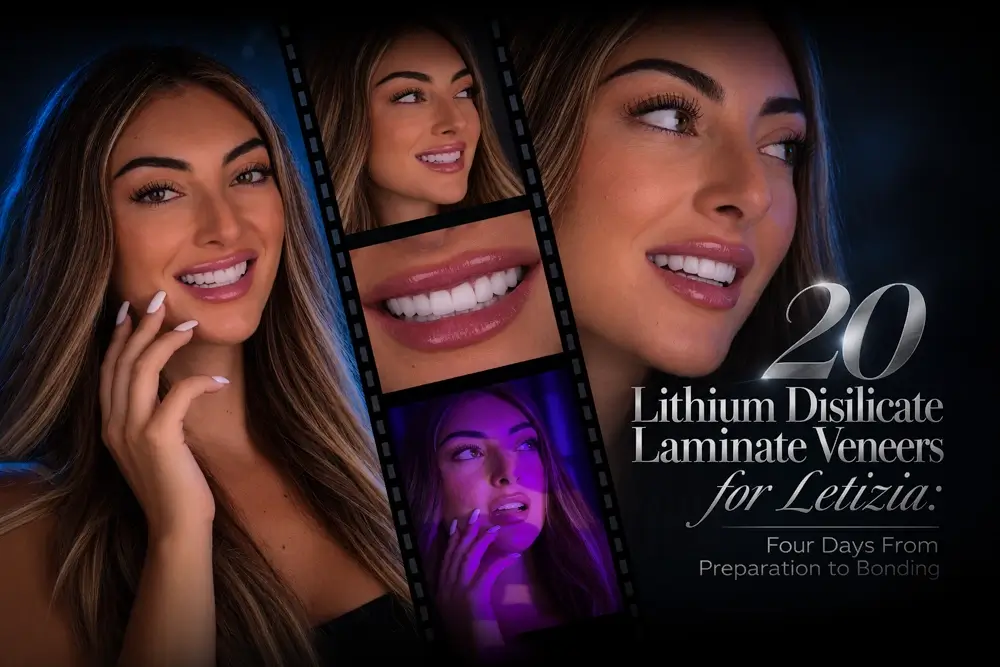
Lithium disilicate laminate veneers are a different proposition from a crown because the tooth underneath is largely kept rather than reduced. Letizia was treated at International Plus with 20 veneers in shade Om1, prepared on one day and cemented four days later. No implant and no crown appears anywhere in her record. This case study follows what a purely adhesive rehabilitation involves.
Key Takeaways
- The challenge: A full visible smile rebuilt with bonded facings rather than with crowns.
- The solution: 20 lithium disilicate laminate veneers designed as one set and adhesively bonded.
- The technique: Preparation and adhesive cementation recorded four days apart in a single stay.
- The outcome: 20 units cemented in shade Om1 with a night guard fitted to protect the bonded ceramic.
What Lithium Disilicate Is and Why It Suits Veneers
Lithium disilicate is a glass ceramic that transmits light in a way closer to natural enamel than higher strength ceramics manage. That optical behaviour is one reason it is used for thin facings on front teeth.
A systematic review and meta-analysis has reported survival and complication rates across feldspathic, leucite reinforced, lithium disilicate and zirconia laminate veneers (Klein P, et al., 2025). Clinical evidence on the general performance of laminate veneers has been reviewed separately (Komine F, et al., 2024).
Material choice is not a preference applied across every mouth. In practice our clinic records it per case and our 20 unit porcelain veneer case documents a different ceramic at a comparable unit count. Readers comparing materials directly can see our guide to E-max against zirconium veneers.
Letizia’s Record and the Four Day Sequence
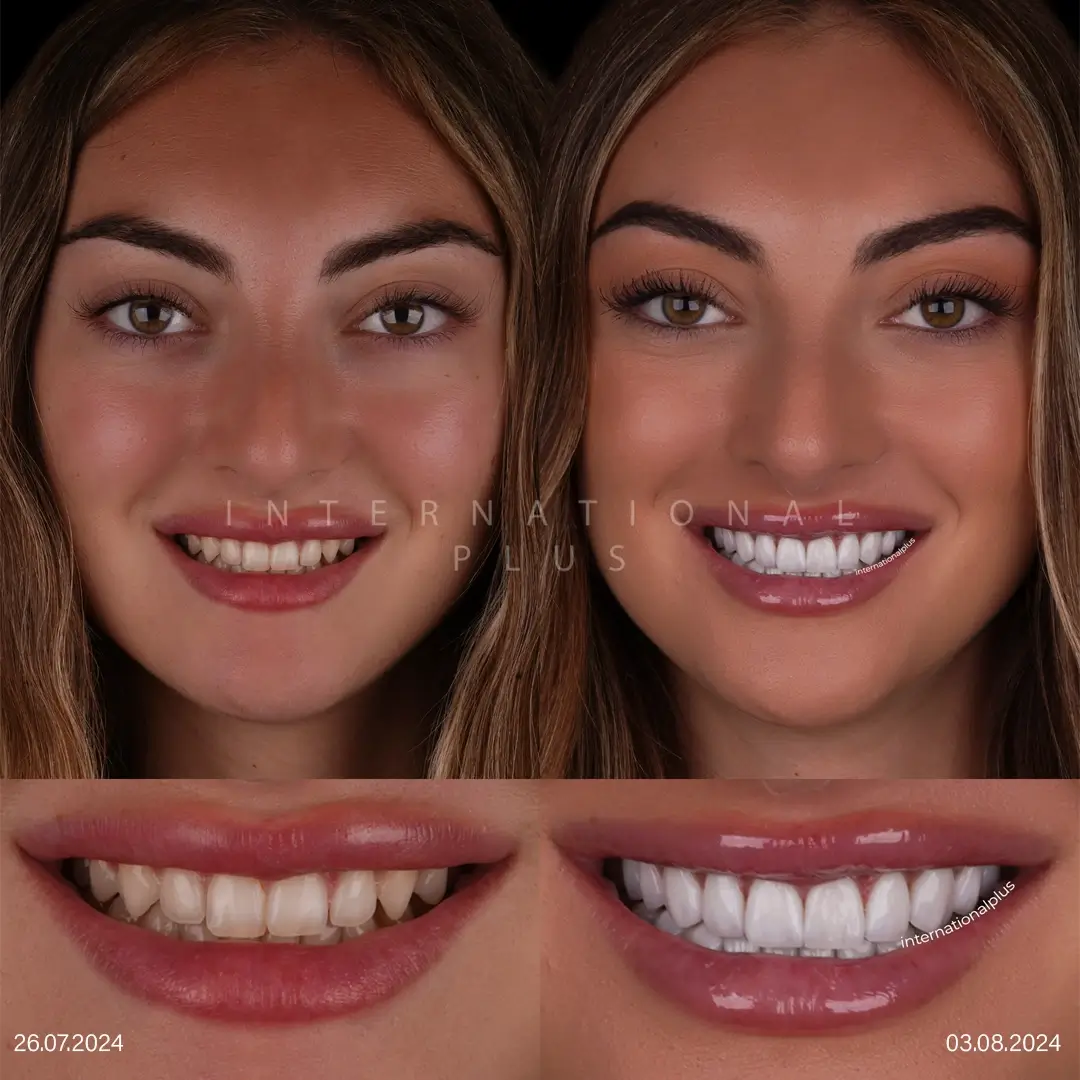
Letizia’s file records a short treatment with a narrow scope. The entries name 20 laminate veneer units, the shade, the laboratory and two dated appointments four days apart.
A laminate veneer is a thin ceramic facing bonded to the front of a tooth, which is why the record lists no crown preparation and no root canal work. Research on minimal intervention in anterior veneer work describes this as the defining advantage of the approach (Araujo E, et al., 2021).
Then the night guard closed the plan. Our clinic records the preparation date and the cementation date separately so the interval that the laboratory worked within stays visible in the file.
| Record | Detail |
|—|—|
| Units | 20 lithium disilicate laminate veneers |
| Preparation | 27 July |
| Cementation | 31 July |
| Shade | Om1 |
| Treatment type | Adhesive only, no crowns and no implants |
| Appliance | Night guard fitted after bonding |
Why Preparation and Cementation Sat Four Days Apart
Four days separate the two recorded appointments. A laboratory interval is the time between preparing the teeth and delivering the finished units and here it covers the production of 20 individual veneers.
An interval of this length is only possible where the laboratory sits on the same site as the treatment rooms. According to published workflow descriptions, digital rehabilitation moves between clinic and laboratory repeatedly rather than once (Ntovas P, et al., 2023). Where those two sit on one site, that movement costs a corridor rather than a courier.
For example, a shade adjustment requested after preparation can be remade inside the same stay rather than after the patient has flown home. Our clinic produced Letizia’s 20 units in its own digital laboratory, the route used for dental crowns work as well. The preparation date and the cementation date are recorded separately in the file.
How 20 Veneers Are Designed as One Set
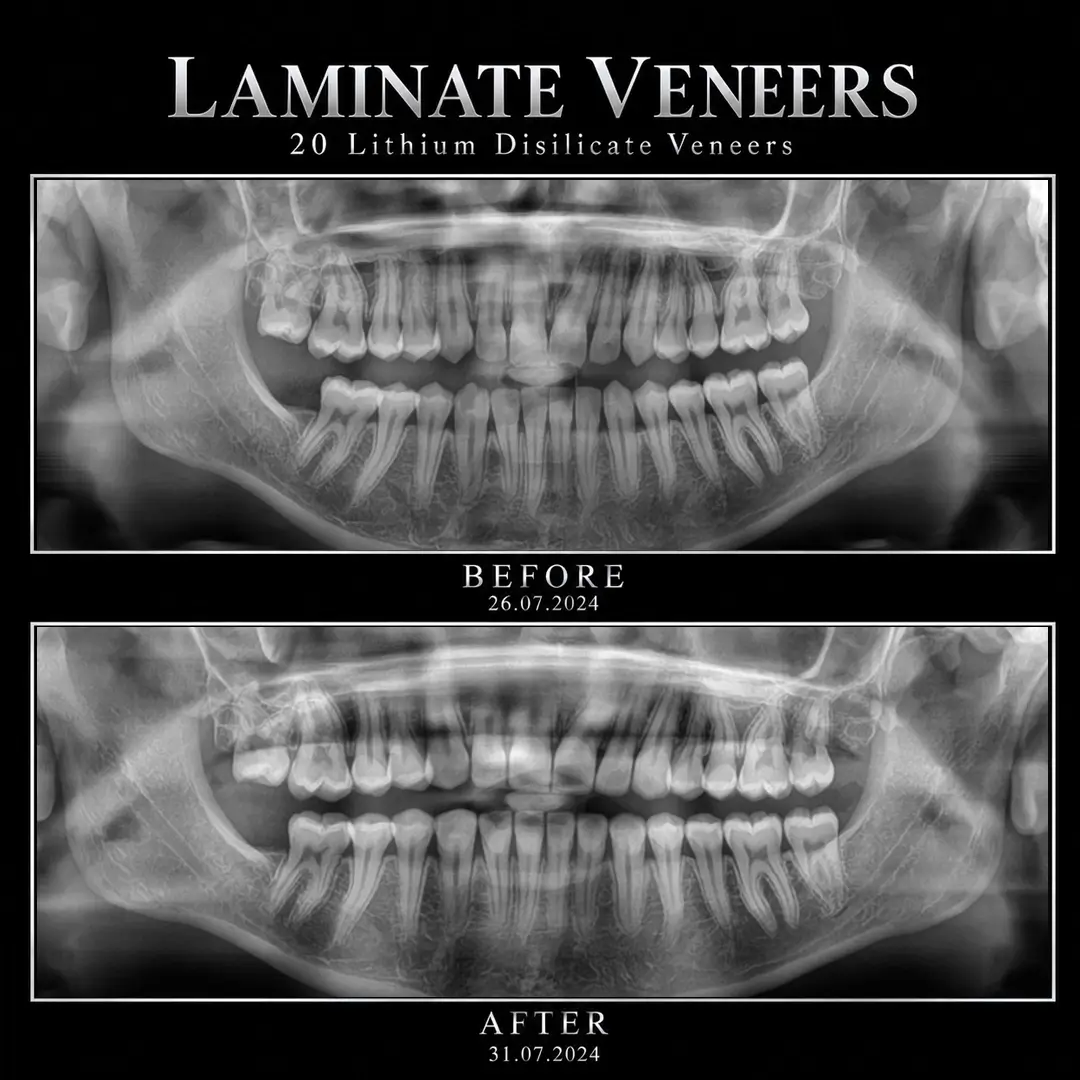
A veneer set is a group of units designed together so that they read as one smile rather than as 20 correct teeth. Twenty units covers the teeth most people show when speaking.
Smile proportion is judged against facial landmarks rather than against the teeth alone. Virtual smile design systems have been reviewed in the dental literature (Zimmermann M, et al., 2015) and digital planning records the midline and the lip line before any ceramic is made. The same approach is set out in our article on how a new smile is planned and offered as digital smile design.
Shade Om1 was recorded for this case. A single shade across 20 units keeps the set coherent but it removes the subtle variation natural teeth show because a uniform smile is the trade a full set makes. Our clinic records that decision in the file before preparation. Patients weighing the choice may find our veneers before and after guide useful.
Bonding and Why It Matters for Thin Facings
Adhesive cementation is the process that bonds a ceramic facing to the tooth and in veneer work it carries the restoration rather than merely holding it in place. A veneer is too thin to survive on shape alone.
A randomised clinical trial following ceramic and indirect composite laminate veneers for up to 10 years reports outcomes for the bonded approach (Gresnigt MMM, et al., 2019). Work comparing milled and pressed lithium disilicate adds production method to the same picture (Sudharson NA, et al., 2025).
In practice our clinic treats the bonding appointment as a clinical stage in its own right rather than as the end of the previous one.
What the Record Shows at Delivery
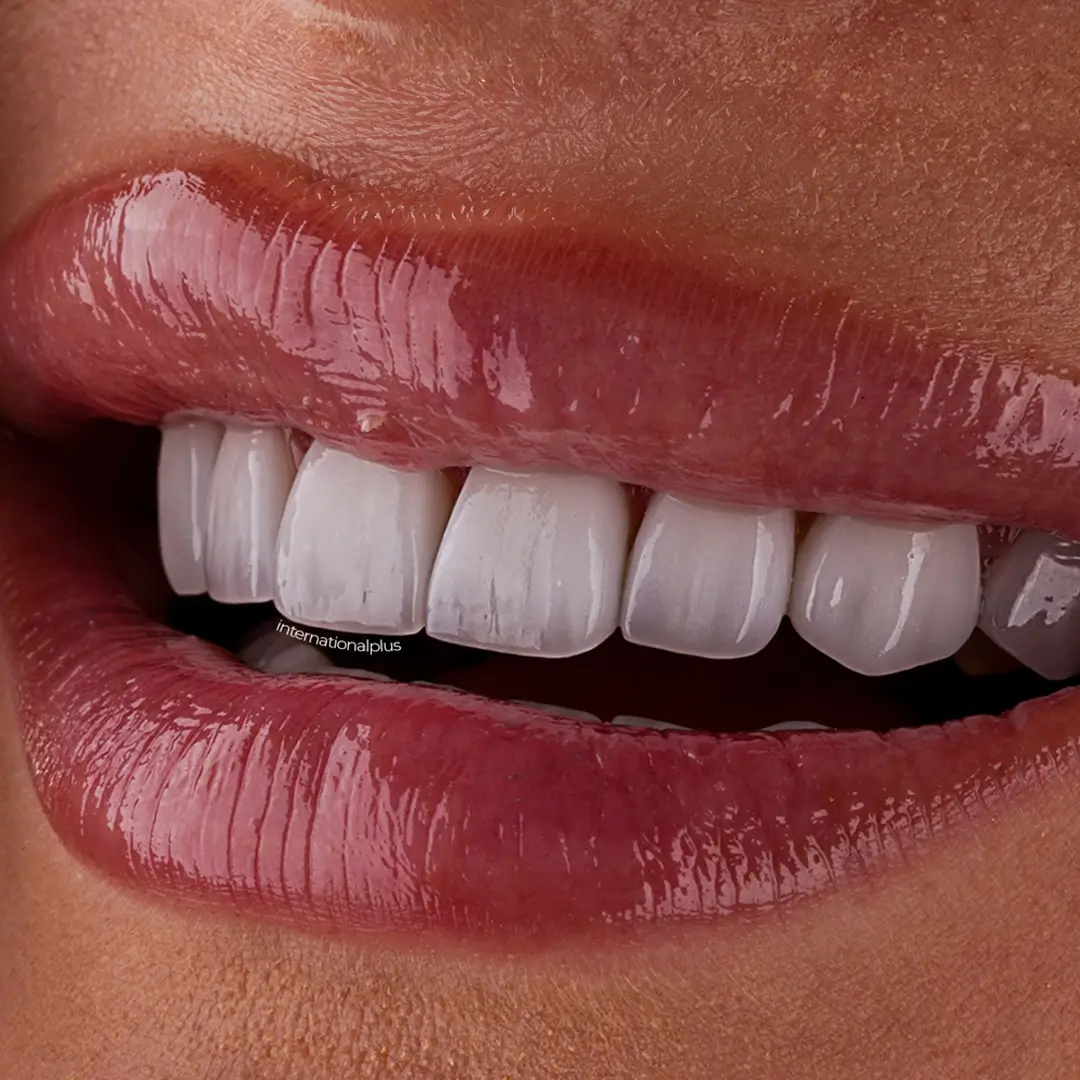
Letizia left with 20 lithium disilicate laminate veneers cemented and a night guard fitted. A guard shields thin bonded ceramic from night time loading, which matters more for facings than for full coverage crowns.
The clinic issues a written record of the material and the shade so a dentist in the patient’s own country can identify the ceramic without guesswork. Enamel removed for a veneer does not grow back so this is a decision taken once rather than reversed later. Patients considering the alternative can compare our guide to dental crowns against veneers and the full Hollywood smile route.
This is one patient’s recorded outcome and individual results may vary. International Plus has treated more than 200,000 patients from 140+ countries since 2014 and holds a rating of 4.8 out of 5 across 5,504 reviews. No clinic can promise an identical result because every smile starts from a different position.
Book a consultation with International Plus if you want to know whether veneers or crowns suit your own teeth.
Frequently Asked Questions
What is the difference between lithium disilicate and porcelain veneers?
Lithium disilicate is a glass ceramic that transmits light closer to natural enamel, which suits front teeth beside untouched neighbours. Feldspathic porcelain behaves differently optically and is layered rather than pressed or milled. Survival and complication rates for both have been compared in systematic reviews of laminate veneers.
How many teeth does a 20 unit veneer case cover?
Twenty units usually covers the teeth visible when a person speaks and smiles, which is measured rather than assumed. The width of a smile differs between patients. Teeth that never show are not prepared without a clinical reason since enamel removed for a veneer does not grow back.
Why were the veneers cemented four days after preparation?
The interval is the laboratory stage, during which the 20 units were produced to fit the prepared teeth. Where the laboratory is on the same site as the clinic, that interval is measured in days. A case sent to an external laboratory abroad would face shipping in both directions instead.
Do laminate veneers need a night guard?
A night guard protects bonded ceramic from the forces generated during sleep. Thin facings depend on the bond to the tooth rather than on bulk so protecting them matters. The guard is fitted after cementation so protection begins on the first night following the bonding appointment.
Are laminate veneers reversible?
No. Preparing a tooth for a laminate veneer removes a thin layer of enamel and enamel does not regenerate. The preparation is conservative compared with a crown but it is still permanent. That is the reason the design stage is completed and approved before any tooth is touched.
Reviewed by Dr. Muhammed Kerem Işıkhan
References
- Klein P, et al. J Esthet Restor Dent. 2025. PMC12076113
- Komine F, et al. J Prosthodont Res. 2024. PMID: 38220160
- Sudharson NA, et al. J Esthet Restor Dent. 2025. PMID: 41024714
- Gresnigt MMM, et al. J Dent. 2019. PMID: 31181242
- Araujo E, et al. J Adhes Dent. 2021. PMID: 33825424
- Ntovas P, et al. Int J Esthet Dent. 2023. PMID: 37819562
Follow us on Social Media
internationalplusofficial
internationalplus
internationalplusdental
This content is written, reviewed, and approved by the International Plus Medical Review Board to ensure clinical accuracy and adherence to strict editorial standards. All medical information is regularly monitored, audited and updated in light of the latest scientific advancements.
However the information provided here is for general informational purposes only and cannot be used for self diagnosis or making individual health interpretations. Results of medical treatments depend on individual anatomy and the unique healing process of each patient. This information should not replace a personal consultation with a qualified healthcare professional. To understand the best options for your specific needs and to receive a personalized treatment plan, we invite you to book a free consultation with the expert medical team at International Plus.
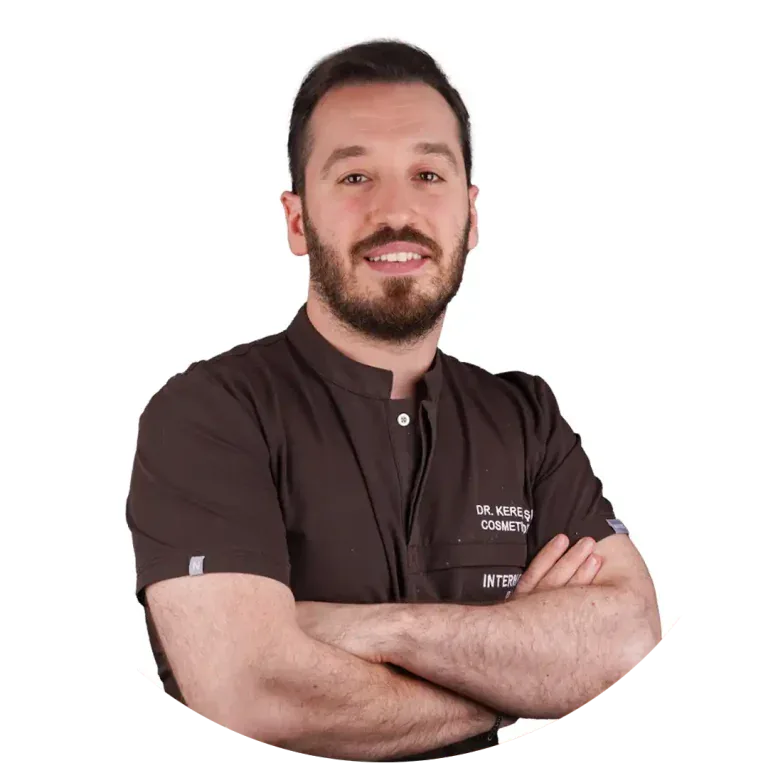
Muhammed Kerem provides comprehensive dental care centered on practical solutions and exceptional patient outcomes for travelers seeking quality treatment in Istanbul.